
First things first: yeah I took a bit of a break. After the Holiday, I had a fatigue spell that didn’t lend itself to doing anything, let alone challenging gelatin recipes. And after that, It Got Hot.
Originally, my plan was to wait for the heat to end. But alas, we live in hell, and the heat is Endless. About halfway through the month I realized I needed to get going regardless of the forecast, and it took me a few more days to prep for technically the first of my challenging trio: a cold soufflé.
A What Now?
Anyone who’s familiar with a soufflé is right to be confused – it’s not just that soufflés are baked, but that’s the whole mechanism that creates the key effect. Here’s the scoop: a cold soufflé isn’t really a soufflé at all. It’s just a Bavarian cream molded in a way that simulates the look of a soufflé. If you wanna get technical, the recipes I looked at often did involve more or less a crème pâtissière (i.e., pastry cream for us Yanks), and a meringue, but…so do most things.

♫Cousins, identical cousins♫ wait, that reference is older than this cookbook
Funnily enough, the next on my list of challenges is also basically a Bavarian: a charlotte russe.

Anyways, once you make the Bavarian, you tape a soufflé collar to a ramekin or what-have you, plop it in, and let it set.
A Soufflé… Collar?
Yeah, so now we get to the challenge part. When you bake a soufflé, you don’t really need a soufflé collar. I feel like contemporary bakers don’t use them, and a cursory search seemed to confirm that. The idea is you tape something like parchment paper or foil around the soufflé dish to artificially (and temporarily) raise the sides. Once the soufflé is risen (or set, in this case), you remove the collar and take your photo for social media.

A bunch of phonies
In the case of a baked soufflé, I’m guessing that this serves as an optional support to control the shape of your puff, which is why people don’t necessarily bother with it now. But for this imposter, the collar is crucial, and I worried about spillage. This is because most of the examples involved wrapping something around the outside of the dish. What’s stopping your Bavarian from seeping between the rim and the wax paper? Fluid dynamics? Amida-buddha’s mercy? Sheer force of will?
Skip to 19:58 for the mold prep.
Bonus: she struggles to unmold the second one she made, so I will never feel bad about struggling to unmold anything again.
When perusing the instructions contained in the particular cookbook I was using this time around, I had an idea…what if I placed the collar inside the dish? This seemed like a much more spillproof strategy, with the tradeoff of “well now you gotta like, slide it out at the end”.

Yes, that is a gelatin dessert on the cover, and yes, it is…a choice that they made
Since I had more confidence in this technique, that’s what I did. I also thoroughly greased the foil to improve my chances of smooth removal (I do have wax paper somewhere, but I also have a ton of foil we got on closeout, so.) And once it came time to pour my Bavarian cream in, as I suspected, no leaks.

You’ve heard of greased lightning, get ready for…greased foil… I know, I tried.
So, Success?
Well, yes and no. Let’s start with the good news: I was able to smoothly slide out the foil for the intended effect. Sort of.
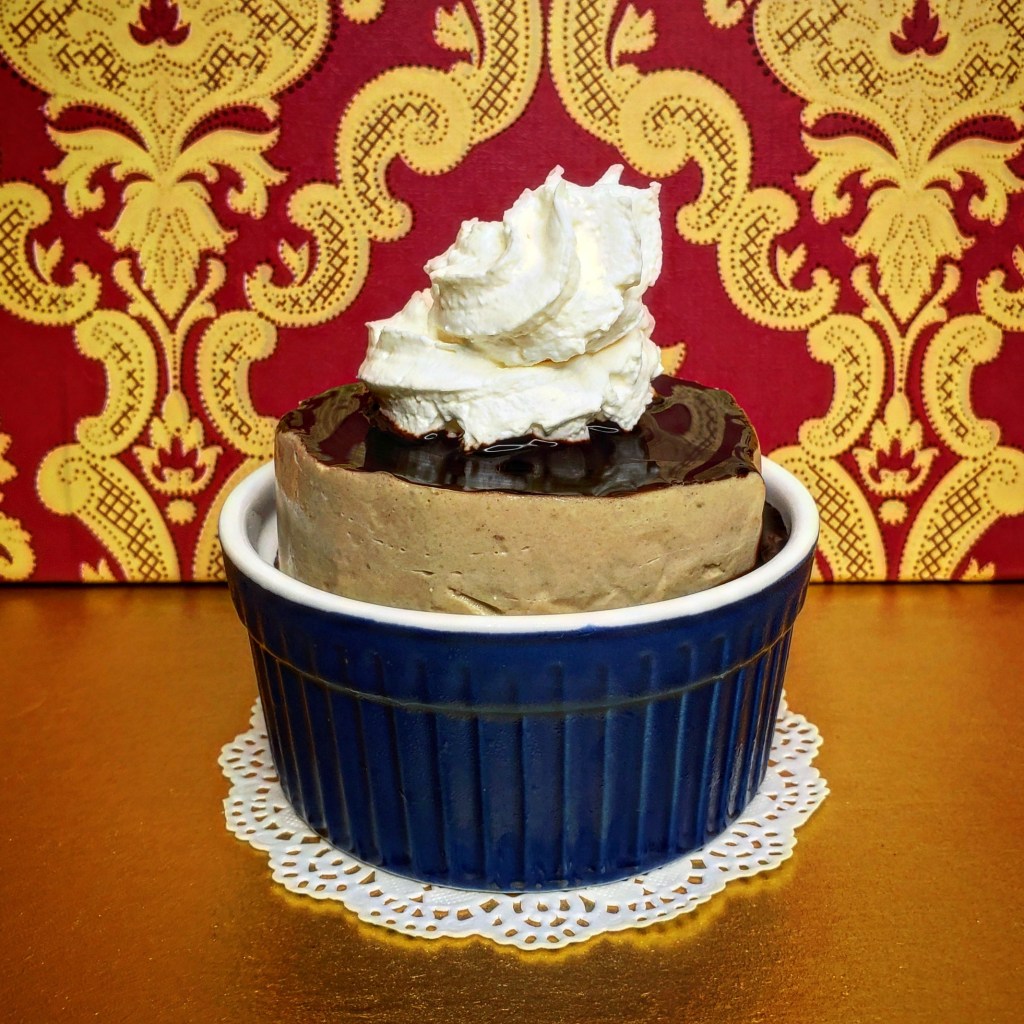
I mean, it’s above the rim, so
See, the ramekins I use have a little…extra space? at the rim, and because I placed the foil inside, I ended up with a sizeable gap between the fake soufflé and the dish. I think the faux soufflé effect would have been conveyed much better had I committed to putting the collar on the outside.
I was also attempting something else with this recipe, and that is: if a Bavarian cream recipe contains an uncooked meringue, can I just leave it out without reformulating it? Personally, I don’t mind taking the risk, and judging by how many people readily admit eating raw cookie dough, I know that I’m not alone. But I also know there’s plenty of Bavarians that don’t have a meringue, and just rely on the final fold-in of whipped cream. (Plus, making a good meringue involves me using a Specific Bowl and a high Luck stat.)
So to test this, and also to reduce the amount of suffering, I chose the simplest cold soufflé in the book, which was just a coffee Bavarian. I then reduced it by thirds, as only one of my taste-testers likes coffee desserts, and made the whole thing sans meringue. So did this work?
Another yes and no. The Bavarian set up just fine, and texture-wise seemed good. But I forgot that by omitting the meringue, I wasn’t just losing egg whites, but also the bulk of the included sugar. Whoops. If I did this again, I’d prolly add in the sugar meant for the meringue in the very beginning when scalding the gelatin. Anyways, this is why there’s no recipe at the end of this. Plus, anyone looking to try making a cold soufflé can just use any Bavarian recipe they like.
This time, a meringue-less Bavarian, next time, a ladyfinger-less charlotte russe! Will it go without a hitch this time? Considering it involves a springform, probably not.
 kelp
kelp 