

The final challenge was something I stumbled across at some point in my gelatin journey – a chaud-froid. Right from the get go, we run into problems…
What the Heck is a Chaud-froid?
Let’s get the pronunciation out of the way. It’s French, which means we got a lotta letters for very few sounds. Chaud is ‘hot’, and froid is ‘cold’, so it’s easy to look up at least. Putting the two together, we get [ʃo.fʁwa], which actually is pretty easy for this East Asian language specialist to pronounce.
(Protip: unless you’re making a serious attempt at learning a language, just substitute whatever r-sound you have for whatever r-sound they have. Not only is this a common strategy by speakers of all languages worldwide, but it usually doesn’t significantly affect comprehension.)
So where does the name come from? The apocryphal story is basically some noble having a craving for cooked cold chicken, and his put-upon cook came up with…this

What are we looking at here? First, you cook some meat (in the illustration above, chicken, salmon, or ham). Then you let it get cold while you prepare a sauce with some gelatin added to it. Next, you coat the cold cooked meat with the gelatinized sauce until you get a smooth surface. Add some edible decorations, and coat the whole thing one last time with a clear aspic for a glossy finish, and jakaja~n, your chaud-froid is ready to…impress?

From the 1979 issue of Bon Appetit
According to the caption, this Jambon Chaud-Froid is “cloaked in Chaud-Froid sauce, which is essentially mayonnaise and chicken stock set with gelatin.”
Mayo, chicken stock, and gelatin? Seriously?? Well, yes and no.
What the Heck is Chaud-Froid Sauce?
First off, there’s very little readily available information on chaud-froids in English. Most of the stuff I found that was helpful was culinary instructor teaching materials, and even then there was caveats. You see, teaching your hospitality school students how to make one of these comes after many, many other lessons, like “Sauces I”, and “Sauces II”, and “Sauces III”…you get the point. So while they gave a lot of useful tips on coating technique, they vaguely hand-waved when it came to “okay but what sauce am I gelatinizing”.
It gets worse – further investigation yielded statements like “well, you can really use any sauce for a chaud-froid”. Instantly, I narrowed my eyes – of the few I had seen pictured, none used a brown sauce, so clearly that was atypical. But I only came across two detailed recipes in my initial search – not exactly an ideal n to determine anything useful. Luckily, with a bit of keyword tweaking, I was able to crack into French internet and boost my survey numbers.
My conclusion? Well, it’s true, people seemed to use any (white) sauce – there was a fair amount of variation. But the mayo mentioned above gave me a big clue that most recipes prolly directed people towards a sauce parisienne.
I’m not an expert in French cuisine, let alone the detailed differences between various mother and daughter sauces, but I am an expert in “Americans made an…interesting…convenience version of this more complicated French recipe”. And sauce parisienne is one of them. And yes, mayo is usually involved.
A more typical sauce parisienne, also known as an allemande, is actually not all that complicated. First, you make a velouté (another easy one to pronounce, [vəluˈte]), which is just a blonde roux plus chicken stock. For us Americans, as this point you have plain chicken gravy. Then you add an egg yolk or two and some dairy. Easy! Now you have slightly fancier chicken gravy.
There’s a second reason why I think sauce parisienne is the default, and that’s a number of times I saw people say “it’s a béchamel or a velouté”. A béchamel also starts with a blonde roux, and then you add dairy. No stock. But most all the recipes I saw definitely had some kind of stock, and it makes more sense that it’s a velouté → parisienne than a béchamel with chicken stock.
Okay, Time To Actually Make This Dang Thing
After I watched Julia Child tell me how to make a sauce parisienne, I wrote out my ingredient list and sent in my grocery order. In terms of the cooked meat, I had already decided to just use a canned ham. They’re small, convenient, and cheap.
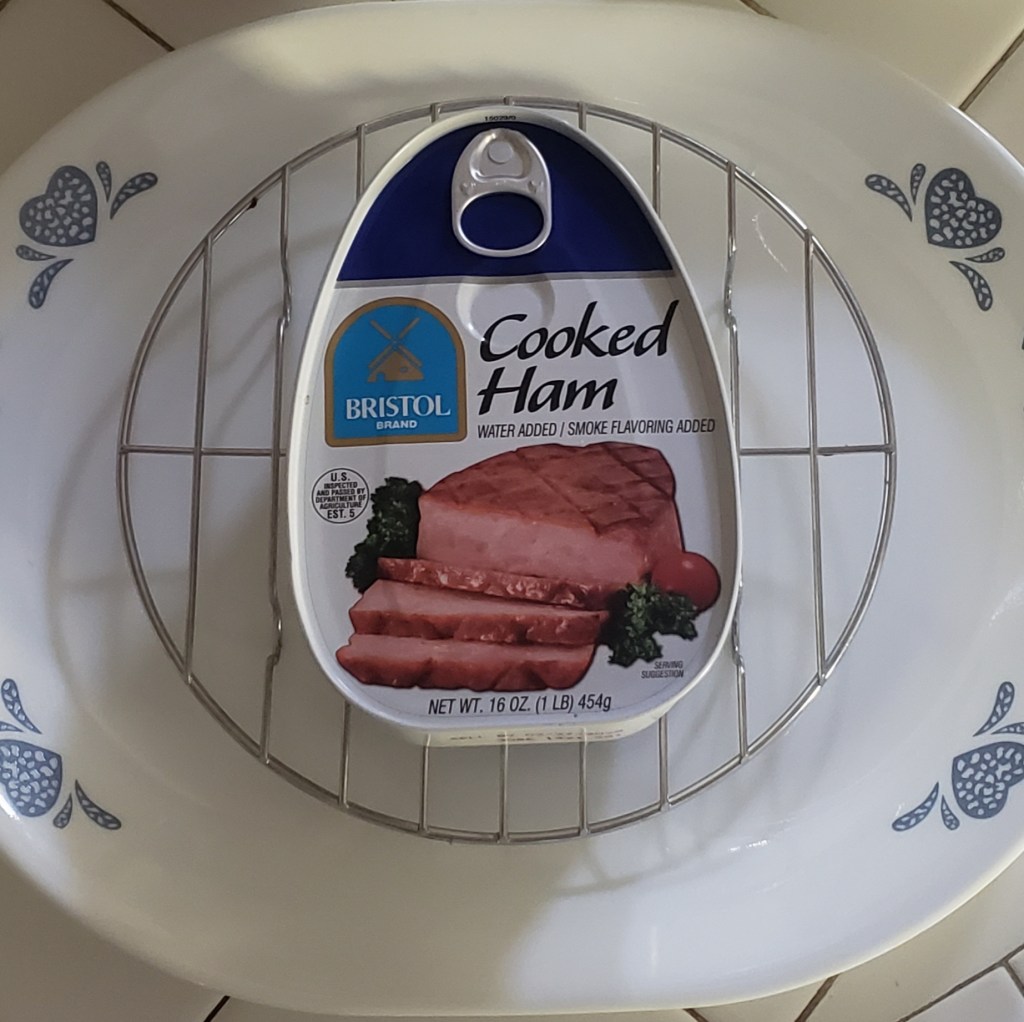
Honestly I think this was like, under four dollars? Which is pretty cheap for anyone unfamiliar with California supermarket prices.
I already had all my sauce parisienne and aspic ingredients sans the chicken stock, so the remaining required ingredients were my edible decor. I decided to go with the general floral design I saw on quite a few jambon chaud-froids. This meant green onions (for the stems) and…something…for the flowers. I lucked out with my gut guess that “those fancy colored carrots they sell in the organic section” would be a low-effort option.
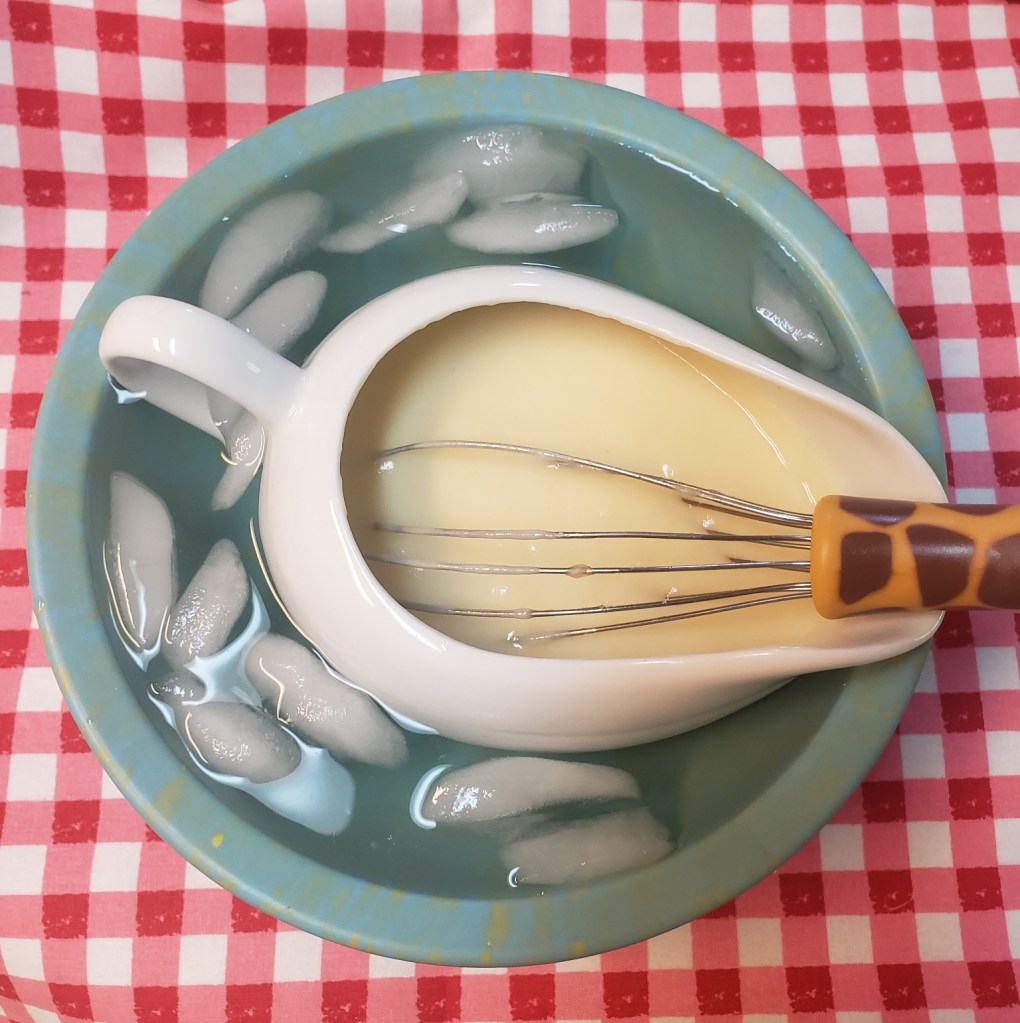
Chicken Gravy in Ice Bath, 2023
I had to make an educated guess about how much powdered gelatin to put in my chicken gravy sauce parisienne, and I added it a little later in the overall process than planned, but no harm no fowl. (Get it? Sorry.) All the culinary instructors also made it clear that it’s totally expected your chaud-froid sauce will need to be reheated as you go to keep it loose enough to pour, so this is a gelatin dish without time pressure. After I poured three coats on, I figured it was as good as it was gonna get, and commenced decorating with my various blanched vegetable matter.
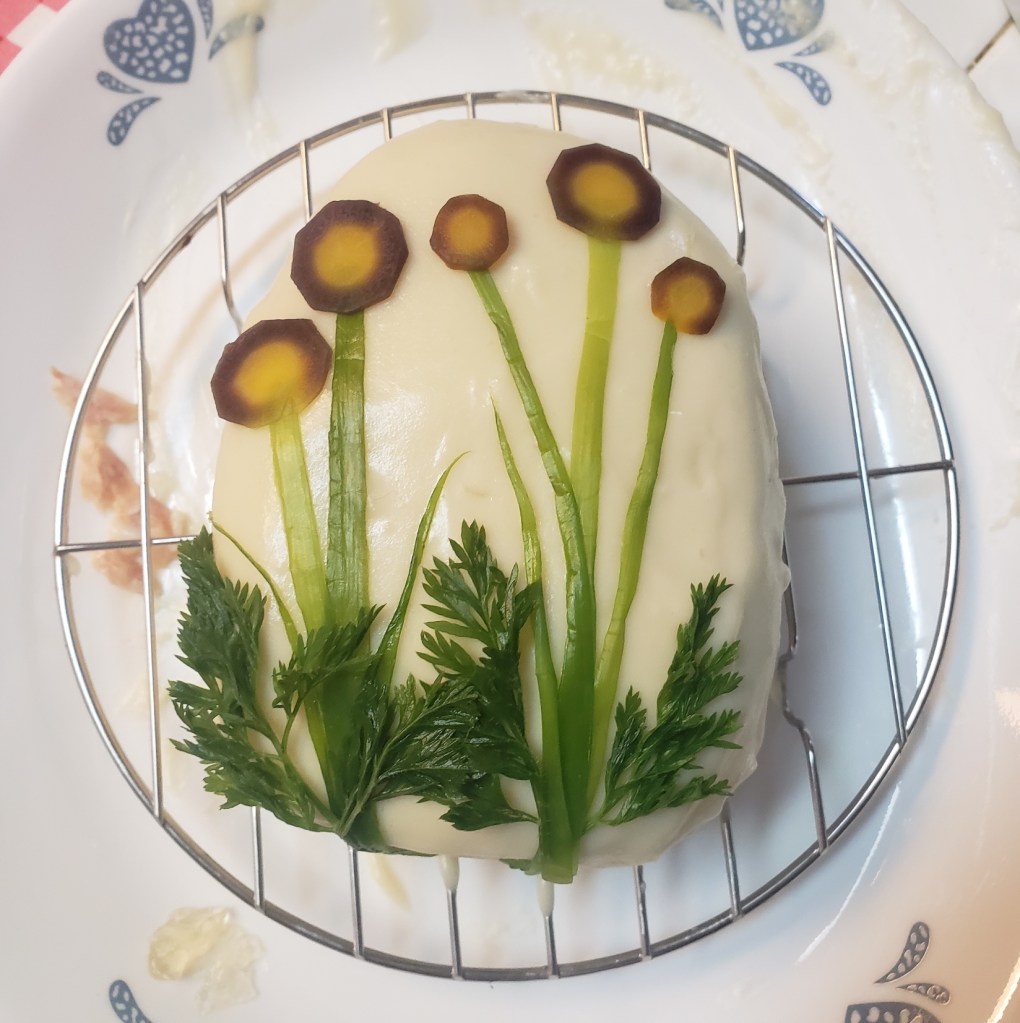
I threw on some of the fancy carrot greens cuz why not
I then finished with the clear coat aspic, which was just chicken stock and a little lemon juice, plus gelatin of course. Overall, a pretty painless process.
Does It Taste Good?

Look at that glossy shine
I cut myself off a slice a couple days after I finished making it, not due to trepidation, but rather cuz my fridge was full of More Time-Sensitive Leftovers, including a Japanese curry I had whipped up with the remaining fancy carrots and green onions. My first bite of cheap canned ham coated with gelatin yielded…cheap canned ham with cold chicken gravy. I don’t really have much to say here, beyond one of my fellow taste-testers remarking “huh, it smells like corned beef hash”.
The whole point of a chaud-froid in current cookery was to have a very fancy looking dish for your cruise ship buffet or what have you that didn’t need to be kept warm. Nowadays, I’m not really sure of any need of such a dish…the best I can think is a picnic, and who’s showing up with a big-ass ham hock to slice and serve?
Well, that’s another Jelly July over and done with. My goal for August is to shift to crafts, but we’ll see what happens…
 kelp
kelp 