
This is another regional Junior League cookbook, this time from Rochester, New York, but it seems to be a step above Memphis’s Party Potpourri. The first printing was in 1981, and I apparently have the 12th printing in 1993, with over two hundred thousand copies printed at that point.
My mother’s family is actually from Upstate New York, which means I recognize a lot of the place names referenced. But it also means I can…easily roast some of the more boastful claims. For example, in the introduction, they tout that the “wine industry centered around our Finger Lakes is the U.S.A.’s second largest wine producer”. I didn’t need google to tell me that California makes the vast majority of US-produced wine, with 84% a common number being thrown out. Even if you, dear reader, haven’t attended a university with a viticulture and enology major, with multiple buildings named after a famous winemaker, and have multiple friends working in said industry, you probably also tilted your head at this misleading attempt to sound important. “But it could be technically true!” Sure, but depending on what time you grab the info, New York is either just barely beating out the state of Washington, or sitting in third.
Okay, my imaginary reader familiar with the Genesee Valley says, they are good at apples up there though, and that’s true! But they can’t help themselves. Immediately before the sad wine claim:
Our Upstate New York area is a fruit belt abounding in cherries, peaches, and grapes. Climatic conditions here provide the ideal growing environment for many vegetables as well and we lead the nation in producing cabbage for sauerkraut.
Does this make California a fruit fukuro obi
First off, my partially Polish self loves that they have to specify “cabbage for sauerkraut”. Us hippies in California are clearly too busy growing stuff for kimchi or whatever, like ‘napa cabbage’ or this ‘bok choy’ nonsense.
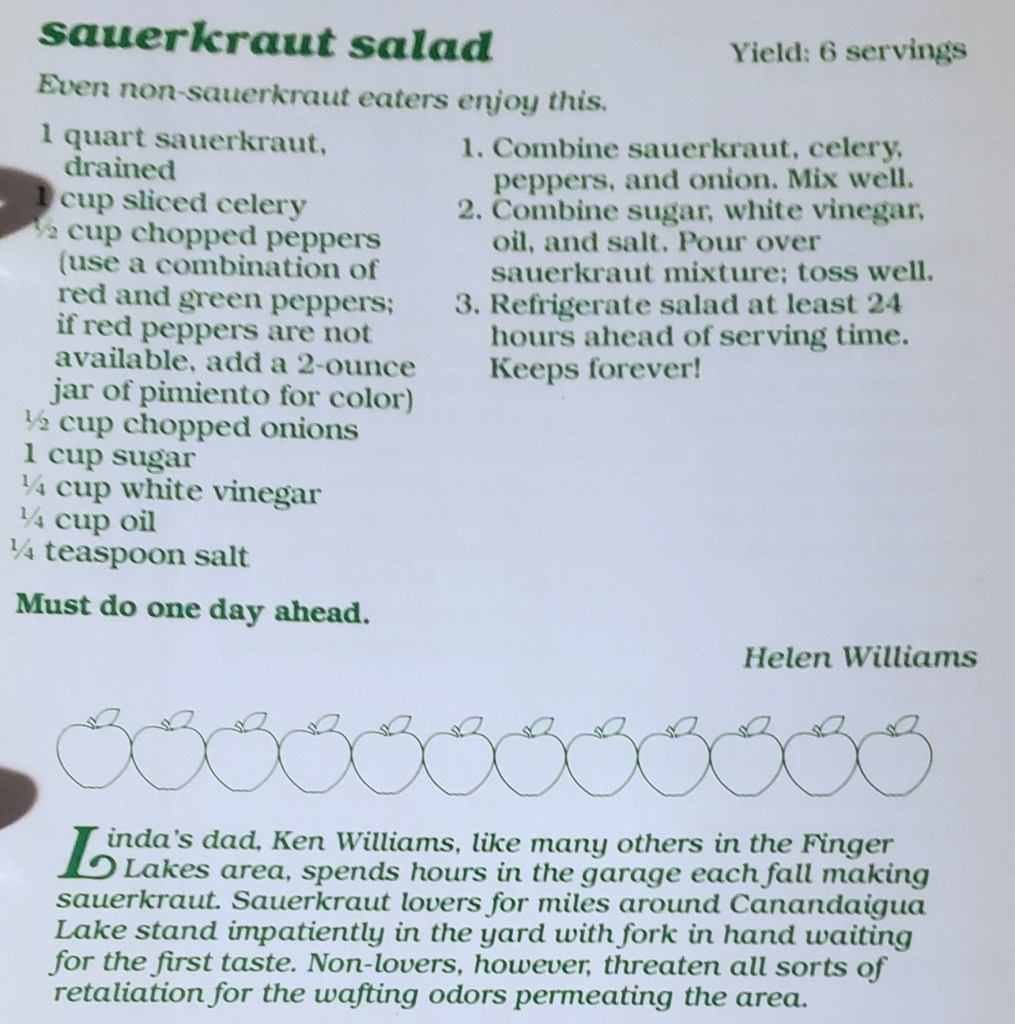
Linda’s dad, known neighborhood nuisance
Anyways, as you might have guessed, these claims are all…claims, alright. According to the numbers in a 2024 report by the USDA, the cabbage one is actually their strongest, weirdly enough, despite it being quantified. (I also learned that cabbage does well in poor soil with poor drainage, so any gardeners out there take note!) Cherry production numbers are divided by variety, but California and the Pacific Northwest dominate for sweet, and Michigan for tart. A website for the Montmorency variety puts New York’s share of the national tart crop at 5%. Michigan’s tart contributions are listed at about 75%, for comparison. As for peaches, New York isn’t even on the shortlists, because of course it isn’t. In fact, neither cherries nor peaches are mentioned on their 2024 USDA State Agricultural Overview. And you can guess where they stand on grapes.
Sharing this at the dinner table, my parents immediately volunteered some helpful information for those unfamiliar with the greater Finger Lakes area
Both: You know what they got a lot of? Prisons. (someone starts listing off prisons)
Mom: We have our own Wall Street, and it’s the wall guarding the prison…We had the first [execution by electric chair]!
Dad: You know what’s great about that, Edison paid off the prison to do it with alternating current, so that they could claim direct current was safe, but alternating current killed a guy…[Upstate New York is] actually a nice area, there’s just no jobs.
Mom: Well the jobs at the prison were pretty good, but yeah, once the factories closed down…
Me: You know later in the introduction they also claim it’s a melting pot (Dad chuckles)
Mom: Well there was [three different varieties of Catholic churches]
And yes, I fact-checked the Edison claim, and it’s mostly true! The short version is Edison had a mole in the company that made the chair.
Are You Just Going To Ridicule These Poor Ladies
No, no. Let me give them some credit – their cookbook is very well designed. It has a folding cover to allow it to stand on counters, something I rarely see. The cover itself is the same sort of plastic-coated deal a school binder might be, meaning easy cleaning. And the three-ring binder construction also means you can easily remove individual pages for your convenience.
There’s also a crapton of recipes in here. My estimates start at 600 total and go up, in the following categories:
appetizers and beverages (i.e., stuff you’d serve at a party)
soups & sandwiches
breads
salads & dressings
eggs, cheese, & pasta
vegetables
meats
poultry
fish & seafoods
desserts
cakes
cookies
and of course applehood
I did a cursory corpus search for the string “applehood” and mainly got mentions of this cookbook along with a few philosophical treatises. The section bearing its name also has no recipes, just some general information about apples.
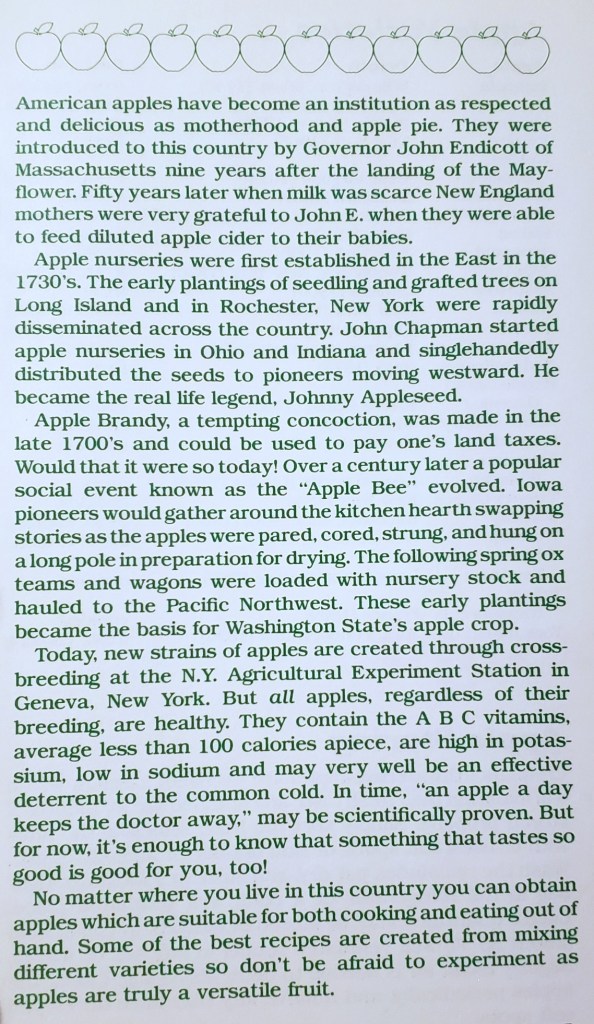
Interestingly, they mention the “N.Y. Agricultural Experimental Station in Geneva” working to create new varieties, but left out the sort of important bit all locals would know – this is Cornell University’s Great Apple Work. It’s even since been rebranded “Cornell AgriTech” (boy do the techbros love CamelCase), but yeah. Weird to make all these vague claims about fruit and vegetables and not explicitly name drop your local famous agricultural research powerhouse.
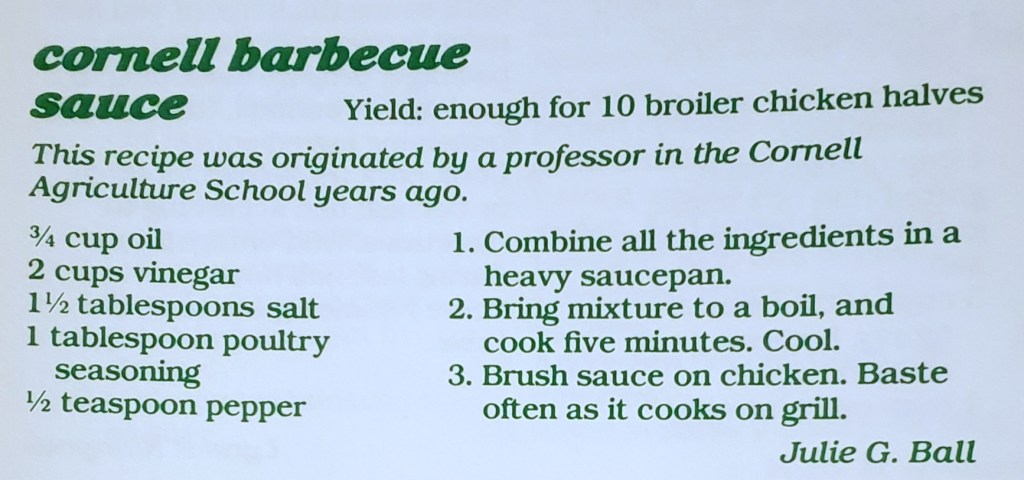
I promise they are better at apples than they are at barbecue sauce
Related storytime: my offices on my agricultural school campus happened to be next to the pomology lab. For years I wondered why the alley between our buildings smelled vaguely of spoiled alcohol. Years. One day when I saw a crate of mangos with a small slice taken from each one, neatly placed near the dumpster, the researchers subtle way of letting locals know “this fruit is safe to eat but legally we can’t give it to anyone”, only then, did it finally hit me – those dumpsters were constantly full of rotting fruit in 100F degree Central Valley summers. I was very ashamed it took me so long to put two and two together like that.
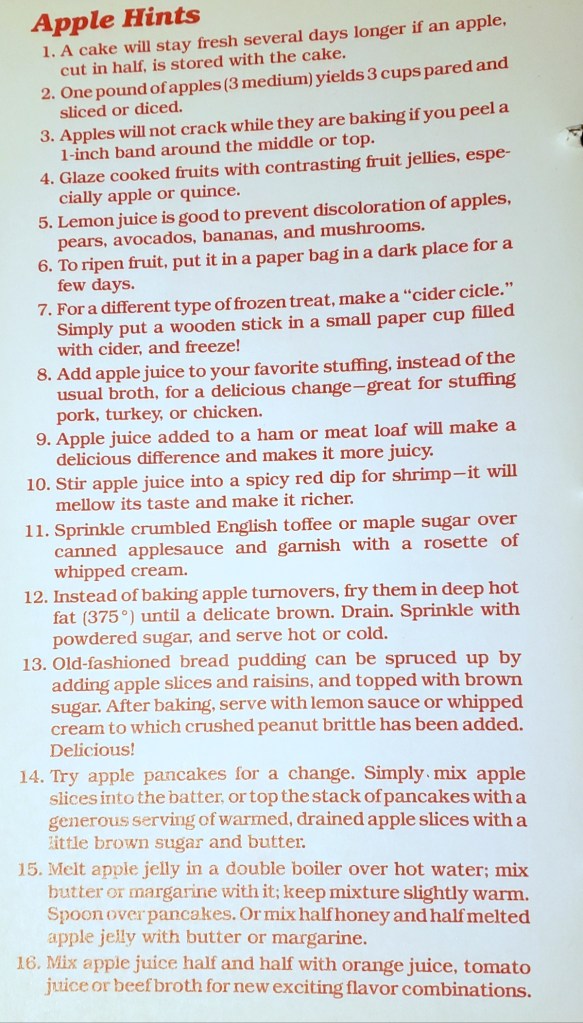
Deep Hot Fat is my favorite R&B group
So You Made An Apple Recipe?
Not yet, no. There’s so many recipes in here I decided I should try to make two, a savory and a dessert. And of course, I could make a savory apple recipe, but I didn’t want to limit myself. And it doesn’t help that available apple varieties here in California don’t really overlap with New York – I’ve never seen Cortlands at my local grocery stores, for instance, and now here in the Apple Future we have all sorts of wild stuff, like Sugarbees, or babby apples especially made for small children a la Cuties.
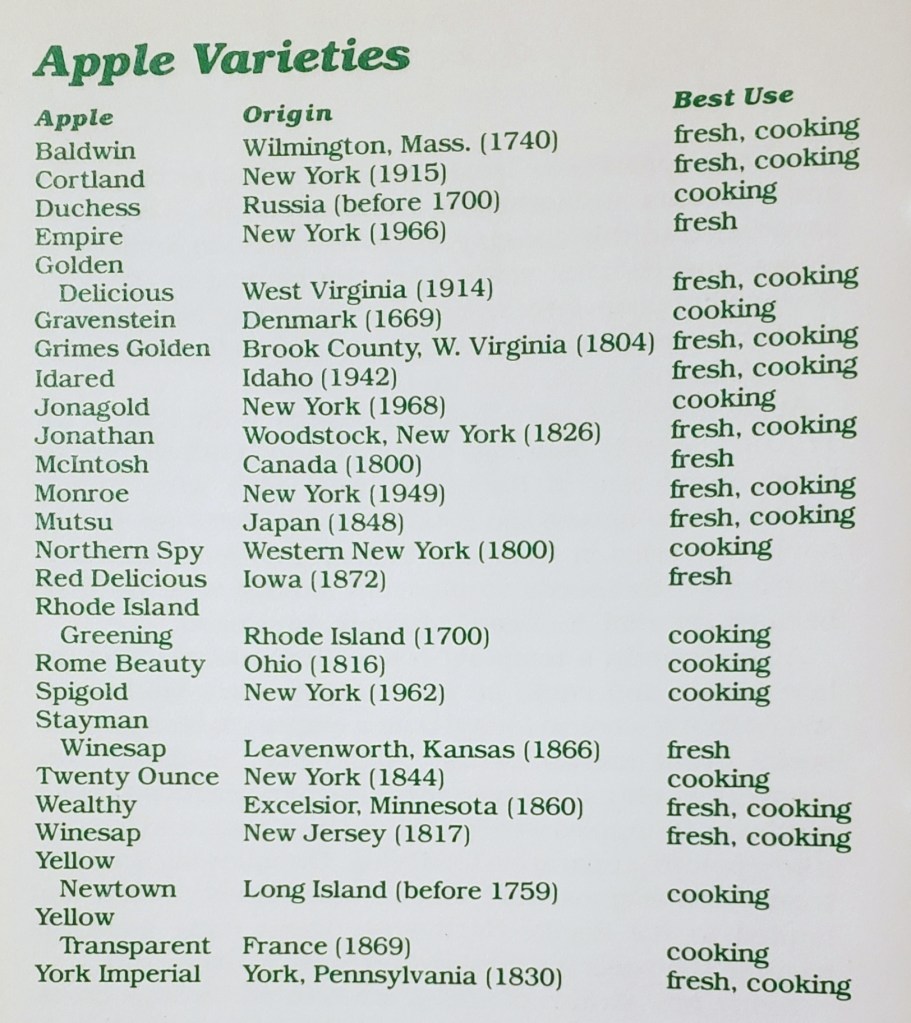
Well, I recognize some of these…
I immediately turned to the eggs, cheese, & pasta section thinking that’s where the good stuff was. After being slightly horrified by this fun little anecdote, I wondered if maybe I should jump ship to a different section.
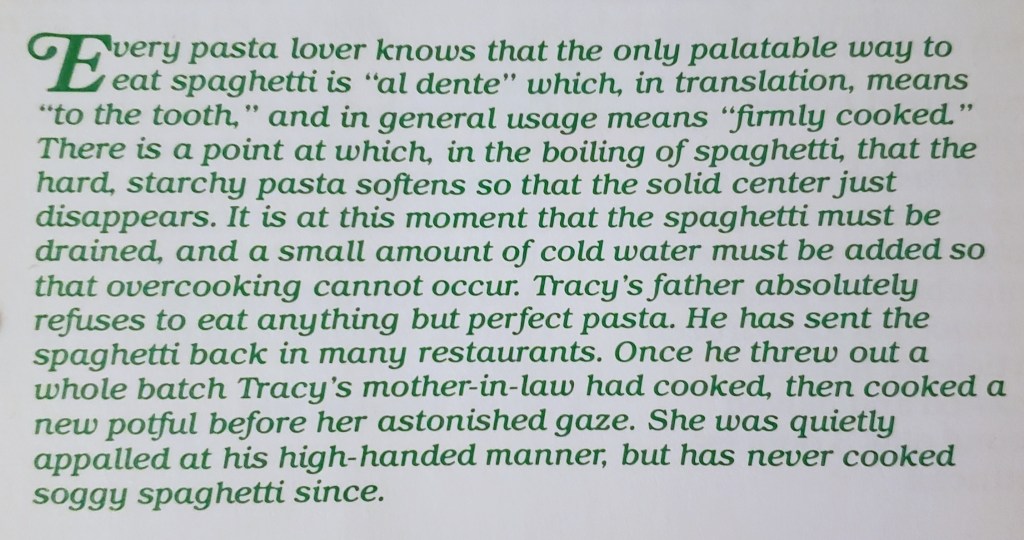
Yikes.
All the recipes have a line of copy under the title by the way, something I do not envy the copywriter for. Every recipe. That’s rough. I bookmarked rochester’s italian quiche since it also had an apple icon next to it, which I’m assuming meant it was extra recommended. (Also, if you haven’t figured it out yet, every title is in lowercase. No, I don’t know why.)

Tasty*
Heading to soups & sandwiches, I was tempted by cabbage soup…and then realized I should probably aim to select the apple-marked recipes, if only to help quell the decision fatigue of looking through hundreds of recipes.
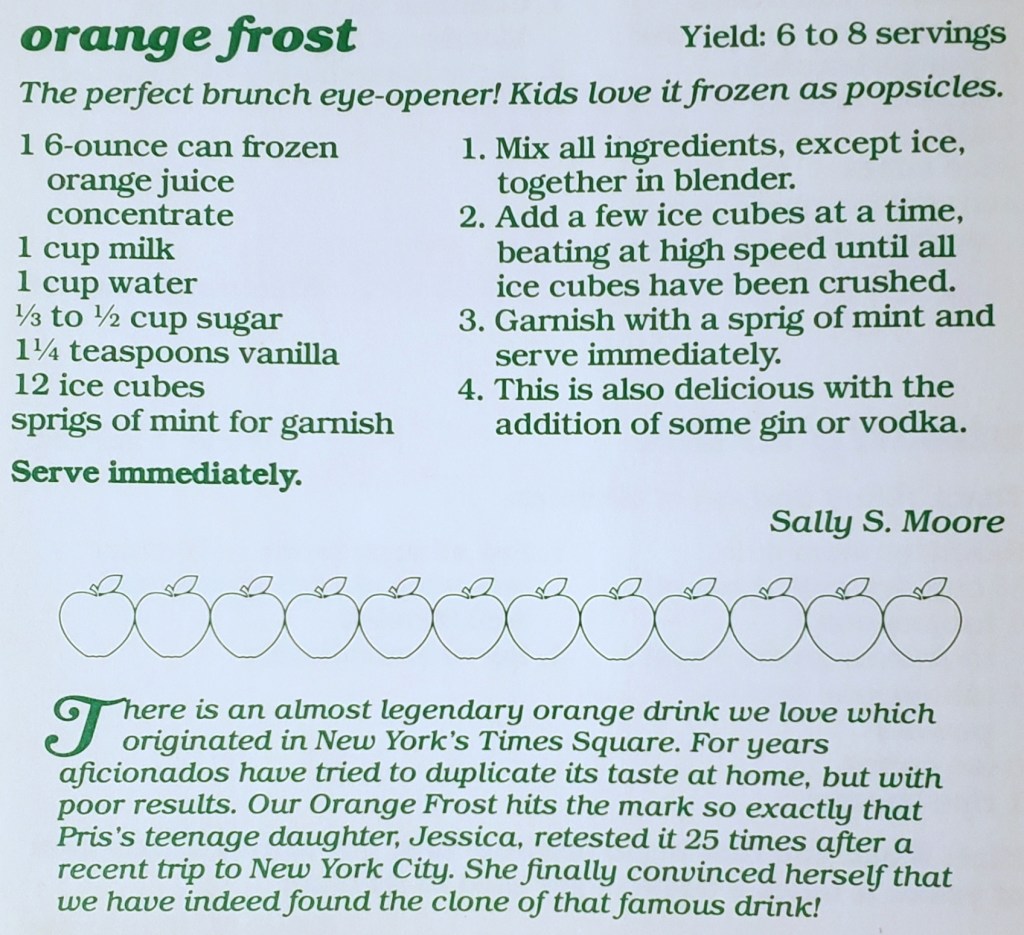
*squints* An orange julius, right? But the location isn’t right…
I ran into what looked like a pretty good ratatouille recipe with the Apple Stamp of Approval, but alas. Whilst one of my taste testers loves zucchini, to me, it tastes like soap, regardless of how it’s prepared. And while I have made recipes I occasionally can’t eat, this was not the time. As I slogged through the rest of the savories, I gave myself more parameters:
- Recipe should have one of the following
- Apple Stamp
- Regional name (e.g., genesee valley pork chops)
- something else unusual
- Recipe should be slightly complicated
The latter criteria I decided disqualified pheasants in sour cream, as much as I wanted to see how easy it was to find pheasants at my local grocery store. Maybe that could be the complicated part. Before I knew it, I had no clear winner and I was at the end of the savories- well, for me anyways. I’m allergic to fish, so I could skip that section. I left my flagged sections with an explanatory note for my primary taste-tester’s second opinion…and she too was quickly overwhelmed. So I decided to give the ladies of the Junior League a break and make one of the few recipes that did imply some level of cultural diversity – babi kecap.
A table of rice? In this economy?
Update: Longtime reader Langstrand pointed out this prolly refers to the Dutch Indonesian Rijsttafel, literally “rice table”, a very large assortment of various dishes along with rice. I did find a few restaurants offering this in New York City proper, but none in the Finger Lakes area.
So it remains to be seen if the recipe writer is a) Dutch, b) a frequent city traveler, or c) a transplant
Don’t get excited now – nearly every “Oriental” recipe in this weighty tome is barely recognizable even as Americanized Chinese food, which is to be expected of these sort of cookbooks in the 80’s.
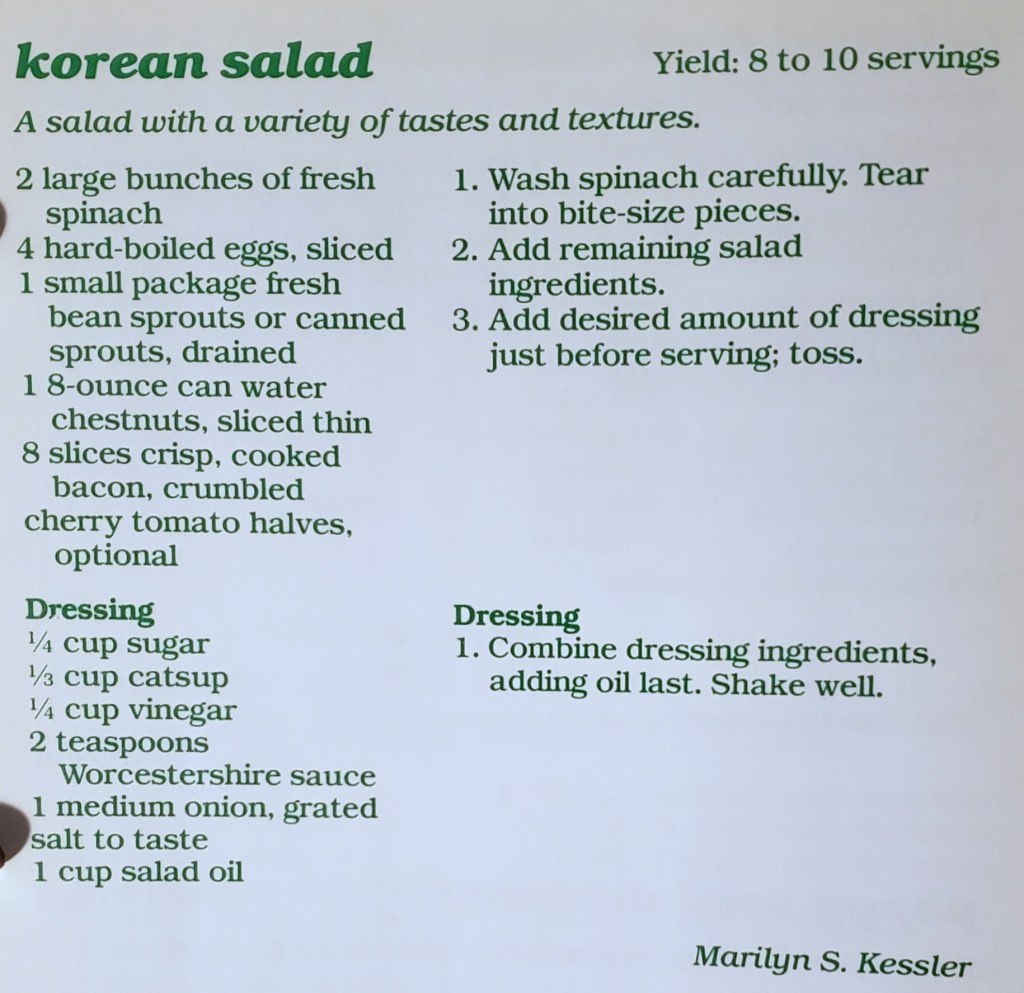
I have questions
There just wasn’t going to be the same level of “Asian aisle” in most local grocery stores as there is now, which inherently limits your options. Babi kecap however, has few ingredients, and so mainly has what I call “the cooking liquid rule”. That is, if you’re making a region’s cuisine, you should ideally use their region’s cooking liquid (kecap manis, in this case) to have it taste right.
That, however, would be cheating in this case. I’ll be using the readily available low sodium Kikkoman in my fridge door, as the recipe just says ‘soy sauce’, and that’s likely what an average Junior League member would have. I checked the rest of the ingredients and general cooking method against some actual Indonesian bloggers’ recipes, and yeah. It’s close! The main other difference is I think the Junior League recipe uses cream of coconut to sweeten the dish as opposed to solely relying on sweet soy sauce.
Did It Come Out?
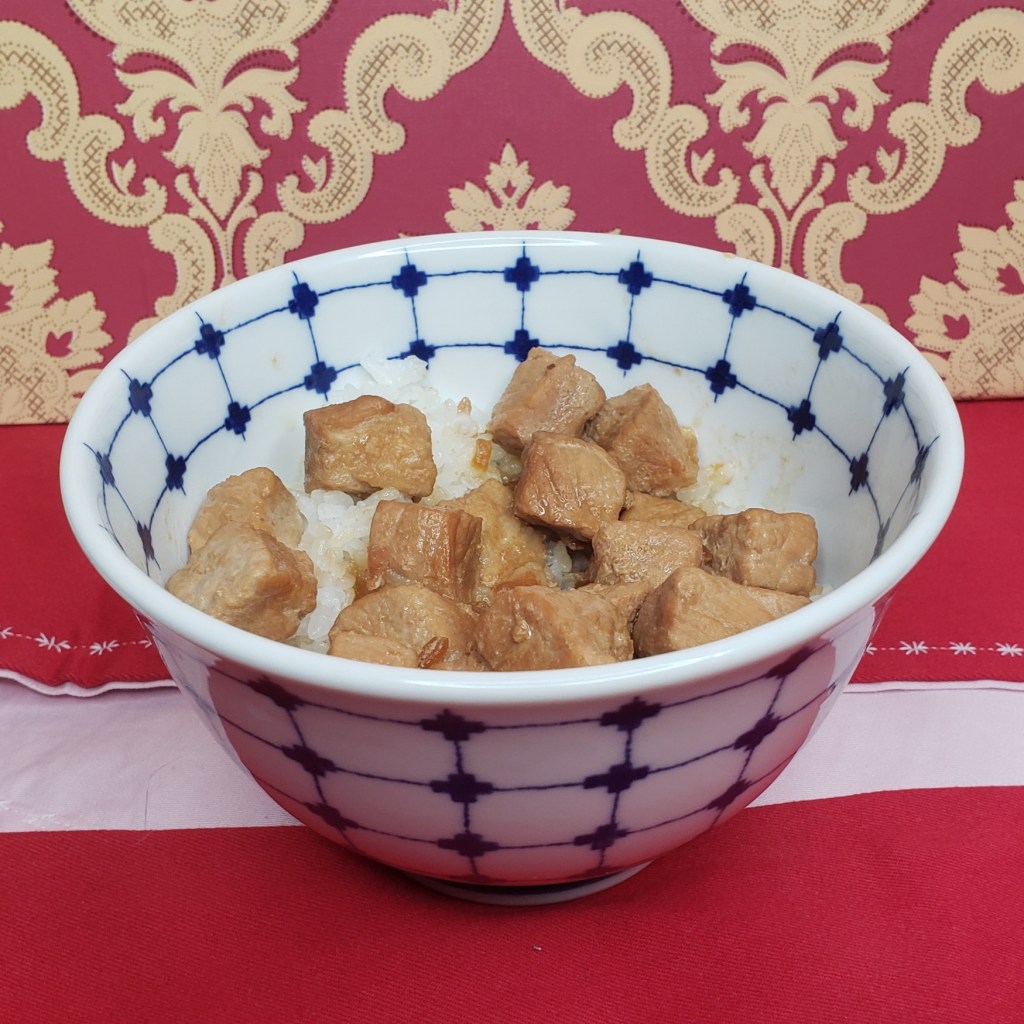
It did! So well I’d make it again. A nice little “just dump it over a bowl of rice” type recipe. I didn’t cook it as long as I should have for it to be fully tender, because I forgot to factor in I’m a Slow Chopper, and we were all hungry, and it smelled so good.
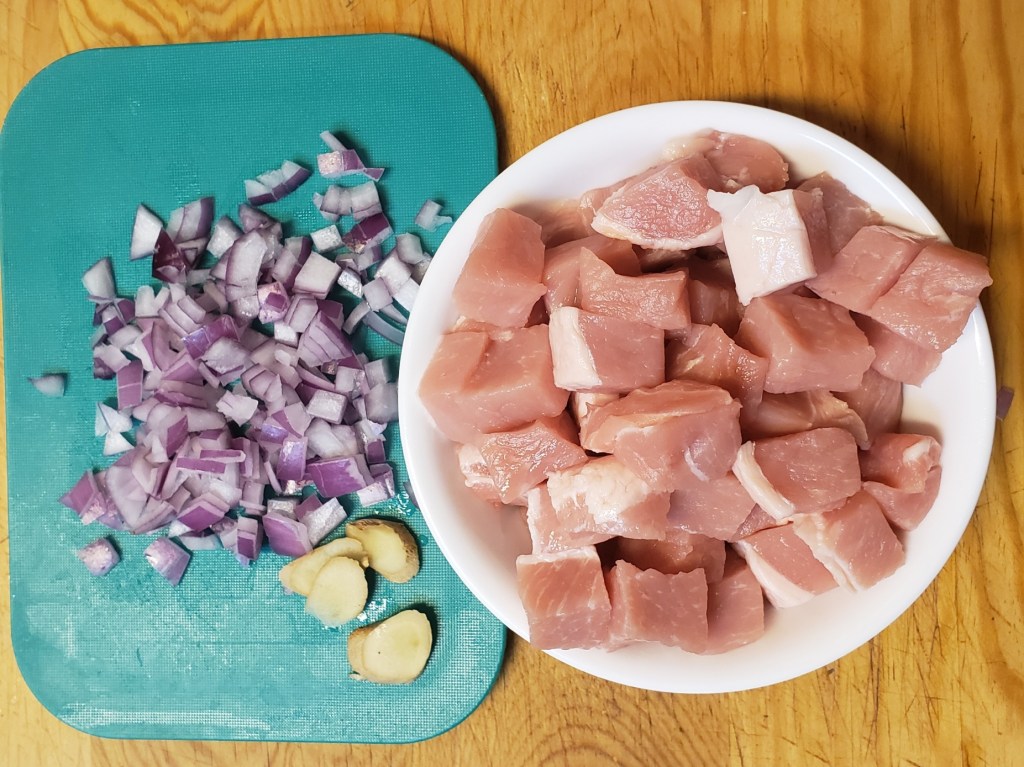
This took me A Long Time
But this is, as I hoped, a very forgiving recipe. I used boneless pork chops instead of pork belly, cause that’s what they had at the store, and just cut them into cubes. I also used jarred minced garlic, and I decreased the red onion by half for the two out of three of us with the ol’ acid reflux. I’d say as made, this isn’t really babi kecap so much as like…a generic Asian dish based on babi kecap made from stuff you can easily find at any US suburban grocery store, but that’s what I expected. My version is below:
Recipe
Babi Kelp (Braised Pork Bowl)
Makes enough for 3 people-ish
Rice of choice
1 pound boneless pork chops
Half a (red) onion
Garlic cloves (or jarred minced garlic)
Ginger root
Cooking oil
~¼ cup soy sauce
~¼ cup coconut milk
Sugar or some type of sweetener (optional)
Chili oil type deal (optional)
- Get the rice going in the rice cooker. You might also want some vegetables – I personally would make some steamed broccoli as a side dish.
- Finely chop whatever sort of onion deal you went with, and mince garlic and ginger to preference, and set aside.
(For me this was about 2 tablespoons of garlic and 1 tablespoon ginger…the latter I would just microplane next time. Much easier.) - Cut the pork into bite-size cubes, and stir-fry them in a large saucepan or wok at high-ish heat until sides are evenly browned.
- Add in aromatics from earlier and continue to stir-fry for a minute or two until everything’s a bit softened up, then lower the heat to medium-ish.
- Pour in soy sauce, coconut milk, and sweetener and/or spicy product of choice and thoroughly combine. Let simmer for an hour or so, or until the pork is tender.
(The original recipe says uncovered, but I left it covered, otherwise you might have to re-up the liquid.) - Take off heat and ladle over rice. Voila!
 kelp
kelp 