
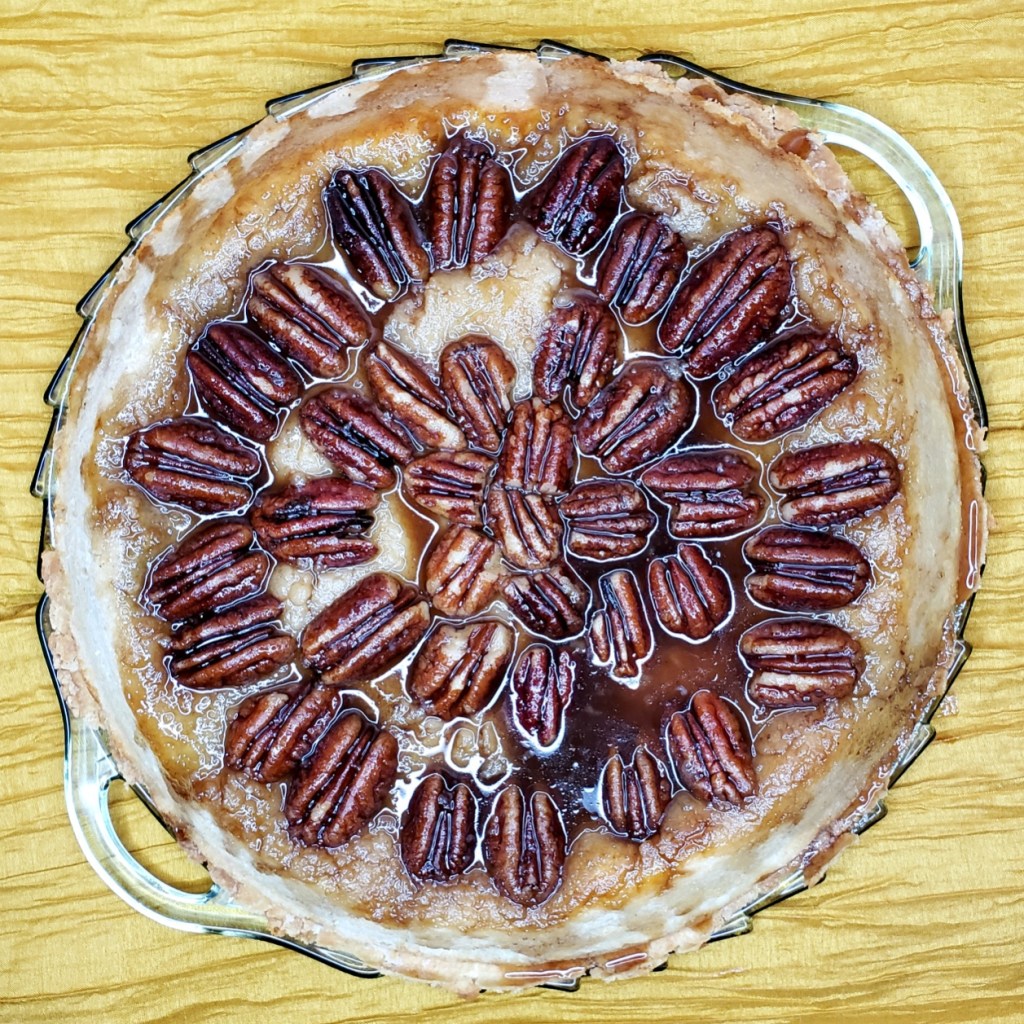
This is part 2 of Applehood and Motherpie, the promised apple dessert recipe. This time, I did successfully stave off decision fatigue by looking at Apple Recipes Only, which surprisingly wasn’t too many. Not that you still don’t have plenty to choose from, but as I kind of suspected, this cookbook isn’t really focused on apples, despite its title.
I also figured, if I’m going to make an apple dessert, I should make a pie. And while I looked through every single sweet section, I did ultimately settle on the very first recipe in the pies section…which was a bourbon apple pecan pie you assemble in reverse.
I had questions. Mainly one question, which was “Has anyone I know ever heard of a pie you flip out of the pan?” I’m very familiar with this concept w/r/t cakes, as Pineapple Upside Cake is a family favorite. But a pie?? I very cursorily asked around and got head-shaking in response. If you have heard of such a thing, let me know in the comments, is what I would say if I had them turned on, but I don’t, so you can’t.
Outside of the whole “flip it upside down afterwards”, the ingredients looked fairly solid. Pie crust seemed fine, though I did dread making a pie crust (more on this later). Filling looked fine. I like pecans. So I told myself “Well, even if it ends up being a mess, it should still taste fine” and forged ahead.

My artful arrangement of pecans for the top of the pie, which is on the bottom, until it’s on the top
Weirdly, the flipping it upside down thing wasn’t a problem! Well. Mostly. I’ll get into that later. But this whole ordeal reminded me of why I don’t bake pies from scratch if I can help it.
The Upper (and Lower) Crust
On the day of our first winter storm, I decided I would do my best to grind out making the pie, since everyone was stuck at home anyways. First off, I decided to dig out my very heavy food processor from the back of a kitchen cabinet for the pie dough. Part of this was I couldn’t remember if I had replaced our missing pastry cutter (yes, I know there’s other ways to cut butter into flour, but a pastry cutter is the true tool for the job).

Now you know why I stage WIP photos on that cutting board
Luckily, I did find all the pieces I needed, and the dough blade attachment does do an excellent job. However, I left my ice water chilling a bit too long, and I forgot that in general, I need to add more water to recipes like these for the same result (even though it was raining outside and therefore we had a decent amount of humidity for once). My paranoia of overworking the dough combined with the knowledge that yes, sometimes pie dough is just like that, left me with a pile that was difficult to wrap up in plastic and put in the fridge. But I managed.
The true problem arose when I went to roll out the dough. The recipe calls for a 9”~10” glass pie pan, so I used my ol’ standby rose-colored 9” Pyrex. But our kitchen cutting board is just not large enough to easily roll out a 9”+ circle with a handled rolling pin.
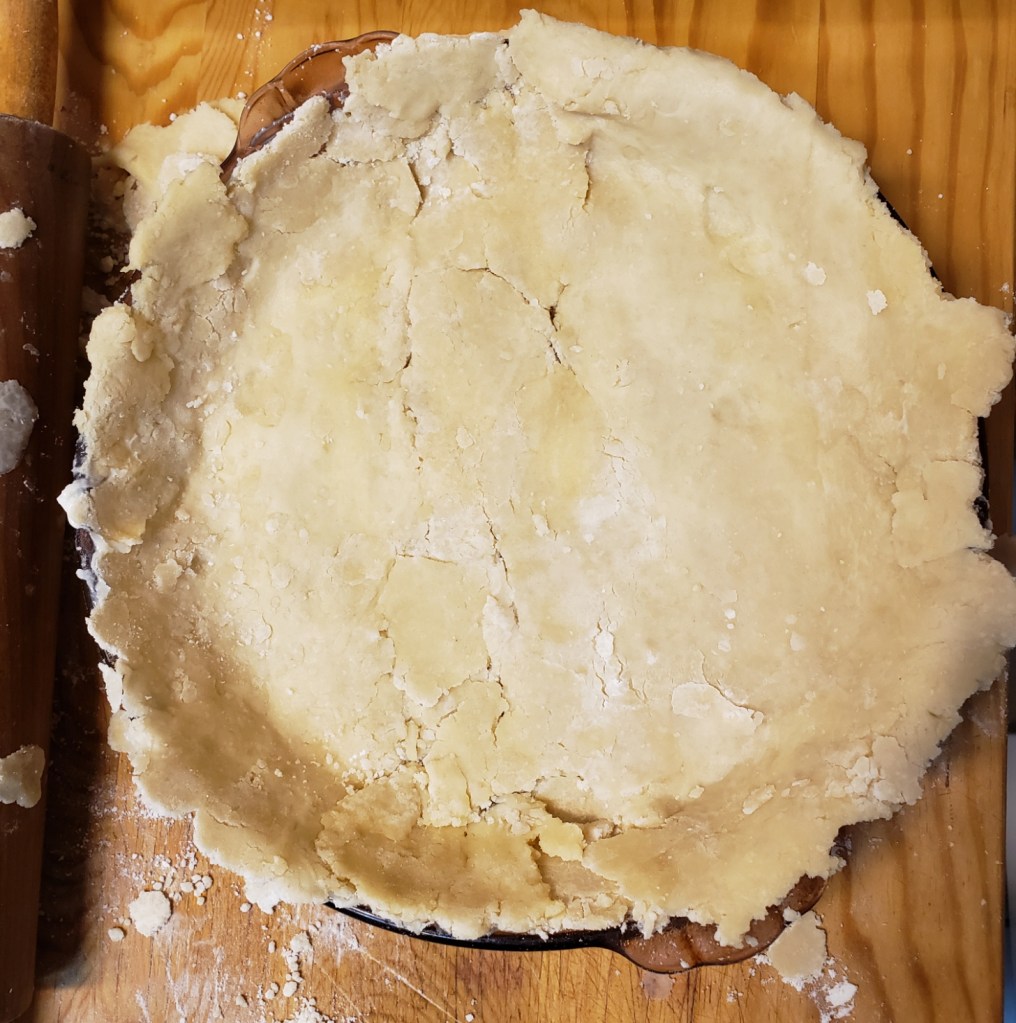
This is fine
If I end up making pie crust from scratch again, like for the upcoming Fall Feasting Fete, I’ll have to remember to pick up a separate big cutting board to preserve some small modicum of my sanity. The dough was also still fairly loosely together, but at that point I was too exhausted to tackle solving that problem outside of the brute force of Rolling. All told, the crust came out fine, but I think I can do better. I’ve made better pie dough before substituting alcohol for water, and I might try that again in the future.
Near Future Applehood
The second big problem was the Apples. I noticed fairly early on that this recipe kind of assumes you know how to make a pie, although they do give some pointers on the pie dough. But they also are Allergic To Weight Measures. I know, I know, Kelp, this is an American thing, much like Apple Pie(?). But also no? While I wasn’t surprised the flour measurement for the pie dough was in cups and not grams, every fruit pie recipe I’ve worked with in the past that’s not berries gave the amount in pounds. And there’s no shortage of Americans on the internet asking “uh, how many pounds of apples would this come out to”, cuz when you’re at the store buying apples, you’re buying them by weight. But wait, it gets worse!
The recipe specifically says:
6 to 8 cups apples, pared and sliced
Putting aside that’s a whole lotta wiggle room, it’s also a bit ambiguous – 6 cups pared and sliced apples? Or 6 cups which you then pare and slice? When I was googling apple conversions, I found someone claiming that the comma is key – no comma means the first interpretation, but here we have the second. But does that really make common sense? You can’t realistically measure apples in cups without slicing them into pieces first. I highly suspect that, like most rules about commas, this isn’t as universal as anyone might claim.
(For anyone really interested in a deep dive of apple measuring, this King Arthur Baking article is for you.)
The problems don’t end there. As I foreshadowed in my earlier post, here in California’s fruit fukuro obi, we simultaneously have apples that didn’t exist when this recipe was written, as well as don’t readily have access to common pie apples that did, such as Cortlands. When I went to investigate what people are using nowadays, I came up with the following:
- Most people like to use 2~3 varieties with slightly different qualities
- In terms of popular choices that I believe are typically available at supermarkets coast-to-coast, Golden Delicious and Honeycrisp seemed to be universally liked, safe choices
- Cortlands are deffo still contenders, along with Pink Ladies and Braeburns
- People are divided about Granny Smith, usually citing the mealy texture. As someone who recently baked some, I have to agree – there’s better tart options
- And then people just start listing all sorts of varieties, many I’d predictably never heard of
I had aimed to get 3 varieties, a mix of Golden Delicious, Honeycrisp, and Braeburns. My resident grocery shopper came back with one of these (Honeycrisp), as well as a giant bag of Pink Ladies which were slightly bruised, but still in okay shape. She also told me there was, as I feared, all sorts of other apples available which I hadn’t put on my substitutions list. Good luck, everyone.
The final apple problem was actually slicing and dicing. Besides being hard on my hands in general, I also managed to cut a bunch of tiny notches into my thumbnails pushing the cores out from our cutting tool.
My mom and I double-teamed processing 9 whole apples and it still took A Long Time. And by the end of it, my back was starting to seize a little bit. I know I’m not in the best of shape, but still. This is definitely the biggest deterrent to making an apple pie, for me at least.
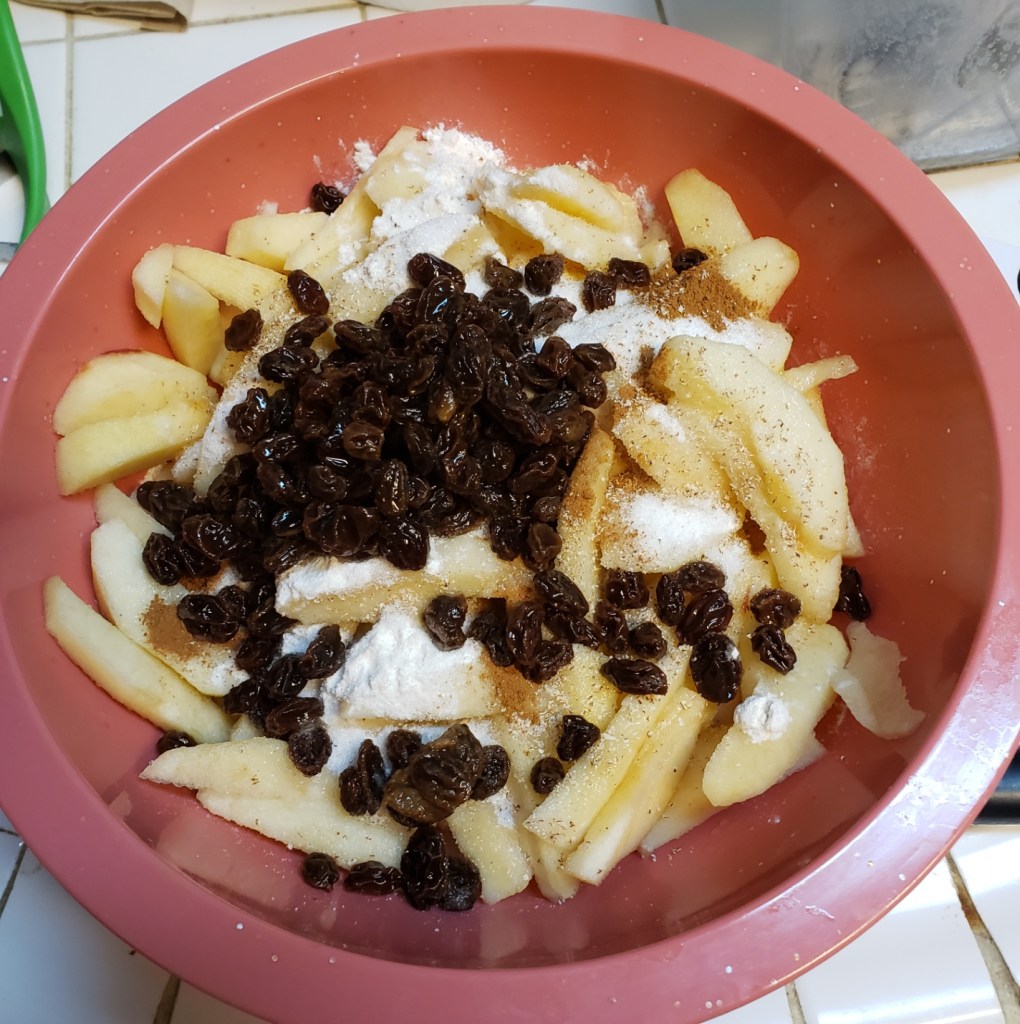
The processed apples plus booze-soaked raisins
The Third Problem
As I spoiled before, flipping the pie out of the pan actually went without a hitch. But I wouldn’t recommend this method to anyone else.
The bottom that becomes the top is formed with pecans that then have brown sugar packed around them. Laying out the pecan halves was fine, but when I went to measure out the brown sugar, I realized I had used our one ⅓ cup measure for the shortening, and the recipe called for ⅔ cups. Figuring it didn’t matter if I reduced the amount, especially since I was using the smaller sized pie dish, I went with ½ cup instead…and that was still too much.
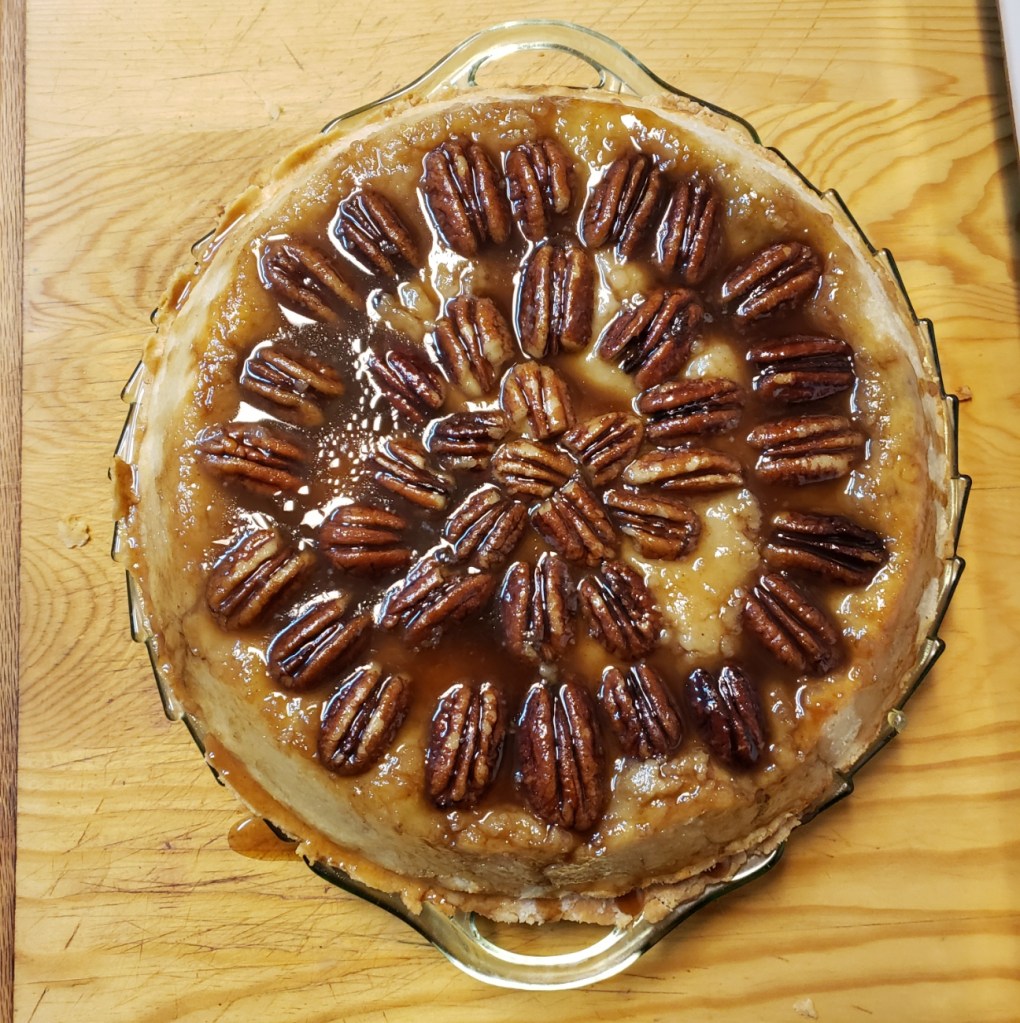
Behold.
In all fairness, I also slightly underbaked the pie, forgetting that my oven runs cold so I should have gone an extra ten minutes. (But the top was golden brown! I didn’t want to burn my scratchmade crust…) But I don’t think that would have saved the soggy sugary mess that was the bottom-made-top. I get what they were going for here with the brown sugar, but I don’t think it’s successful. Luckily, it was easy enough to mop up some of the excess with a paper towel, and since I had used salted roasted pecans, it didn’t end up being overpoweringly sweet. But even if you wanted a similar glaze, I think it best to apply afterwards.
Also, I’m not sure what the point of flipping the pie is. Is it to prevent the pecans from burning? Or is it just a gimmick? It doesn’t have the impact of a pineapple upside-down cake, that’s for sure. Given how fruit pies tend to collapse once you slice them up, I don’t think people would have necessarily even noticed that the pie wasn’t the usual-oriented trapezoidal…wait. What is a pie. A conal slice? Hmm.
My mom mentioned as I was taking a picture if I wanted our pie bird in the photo, and lo, there’s another problem. I just pricked the crust with a fork as instructed, but yeah. If you do own a pie bird, you can’t really use it here. And it’s kinda nice to just, leave the pie in the dish you made it in.
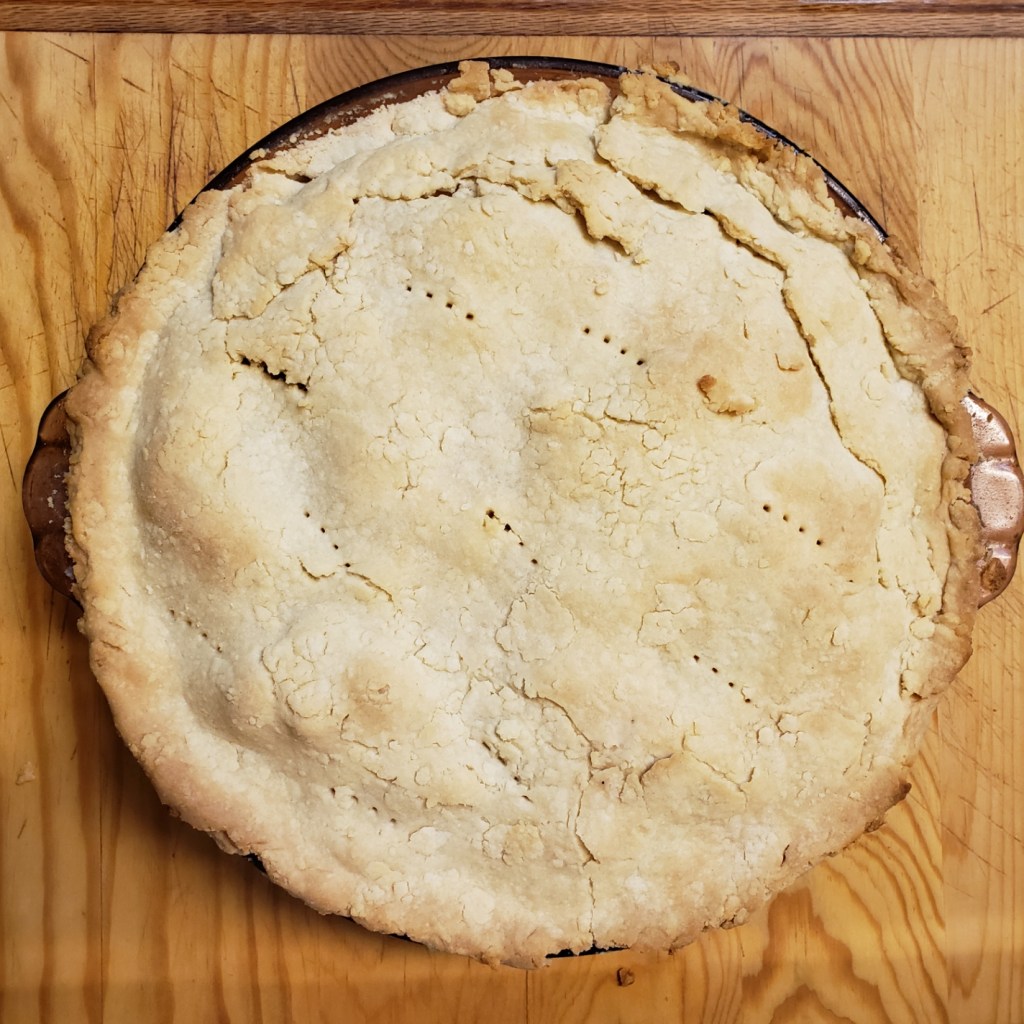
The slightly underbaked right-side-up upside-down pie
But Did It Taste Okay?
Yeah, it’s fine. I didn’t have bourbon lying around (no one in my house drinks alcohol), but I did bizarrely have apple-flavored whiskey, which seemed to work fine for soaking the raisins. I shouldn’t have mixed them in with the filling though, but filled the pie first and then evenly distributed them on the top-bottom. Otherwise, they mainly sink to the bottom of your mixing bowl and end up in a big clump atop your uncovered pie-filling-filled pie.
It’s also kinda heavy – I don’t think whipped cream really cuts it here. This American recommends serving a small slice with a generous scoop of vanilla ice cream. Both my taste testers approved, though. I think its strength lies in the mixture of textures, at the end of the day.
 kelp
kelp 