
For anyone thinking “uh, what?”, I’m working this retro cooking post into the bimonthly Bibliotheca theme, and that’s the best I could come up with. Sometimes the copy-editing juice flows, other times you need to loosen it up with some hot water and hope it doesn’t break.
The Clutter Part of This Post
Lately, I’ve decided the only way my current crowded bedroom will get any better is if I remove some of the furniture items I’ve tetrised in there, and the easiest ones to be relocated are some basic Billy bookshelves (you know the ones) that currently live to the right of my desk, in defiance of all basic earthquake safety guidelines.
However, to move these, I must first empty these, and to empty these, I really need to go through the shelves that are a bit…chaotic. The lower shelf of the one I’m working on is actually all organized and catalogued, as it’s all my Japanese alt-fashion magazines. But you don’t want to empty the lower shelf of a bookshelf first, as that’s a guaranteed way to even further lower your already failing safety grade. The upper shelves aren’t entirely unorganized, but there’s definitely multiple situations that can be described as “piles”.
So I split the difference for my executive dysfunction and started to work on the middle shelves, which house all my vintage and not-so-vintage cookbooks. There is a spreadsheet for these, but it hasn’t been exhaustively updated, and I wanted to go through everything anyways and possibly purge a few things. A nice little bounded mini-project with clear, simple steps, just what my brain prefers.
In the process of doing this, I read through quite a few cookbooks and posted some highlights (and lowlights) in the food channel of my community discord. One lowlight was me crashing out a little at this terribly researched book about Tea, like, the British institution, which was ‘written’ by one man, edited by about five women, had a whole lengthy section more-or-less lifted from an actually good researcher over at Twinings, and was still unsalvageable in many parts. A tale for another tea time, whenever I get to making a recipe from that one.
A highlight, however, was the discovery of one of these weighty tomes I categorize in my spreadsheet as “omnibus cookbooks”. These are usually hundreds of pages and serve as a sort of Exhaustive Reference to Cooking in General. The sort of gift it used to be common to give young women in their 20s, like the New Dinner For Two book tries to be without the usual bulk.
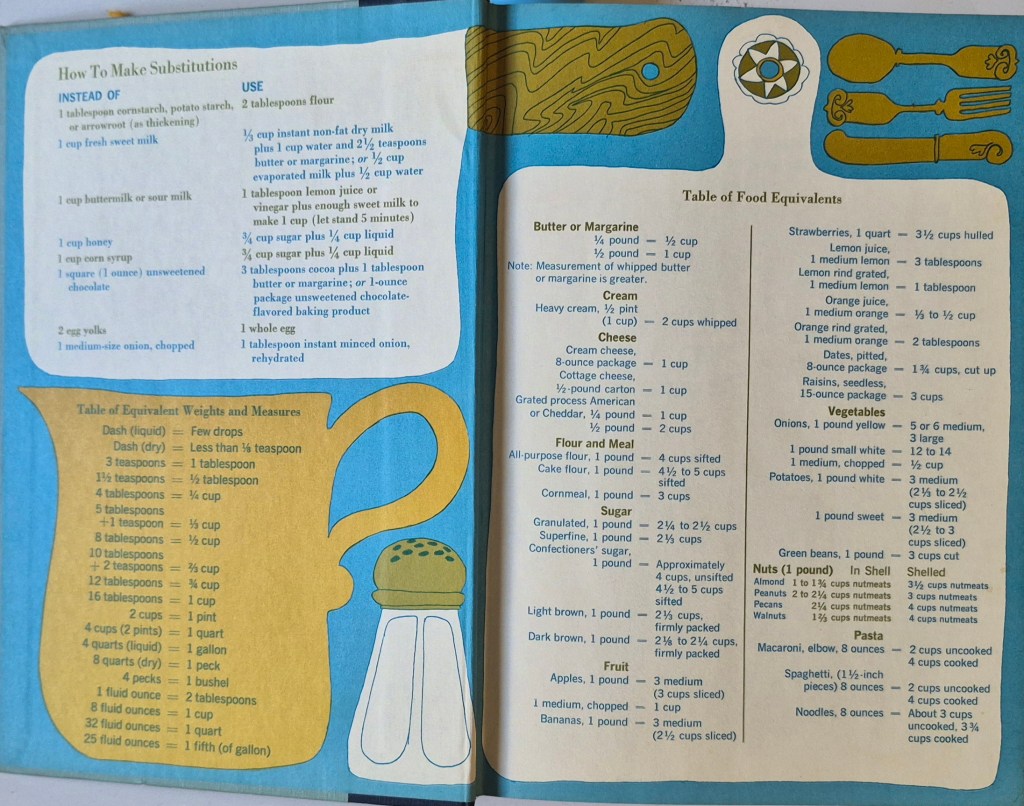
Ah yes, the kitchen staple of ‘instant minced onion’
This hardcover prolly had a jacket at one point, but when I acquired it, it just had the initials AH, for American Home All-Purpose Cookbook.
There wasn’t much of a foreword, but my research senses immediately tingled to the tune of “American Home was prolly a magazine, a la Better Homes and Gardens” and lo! It was.
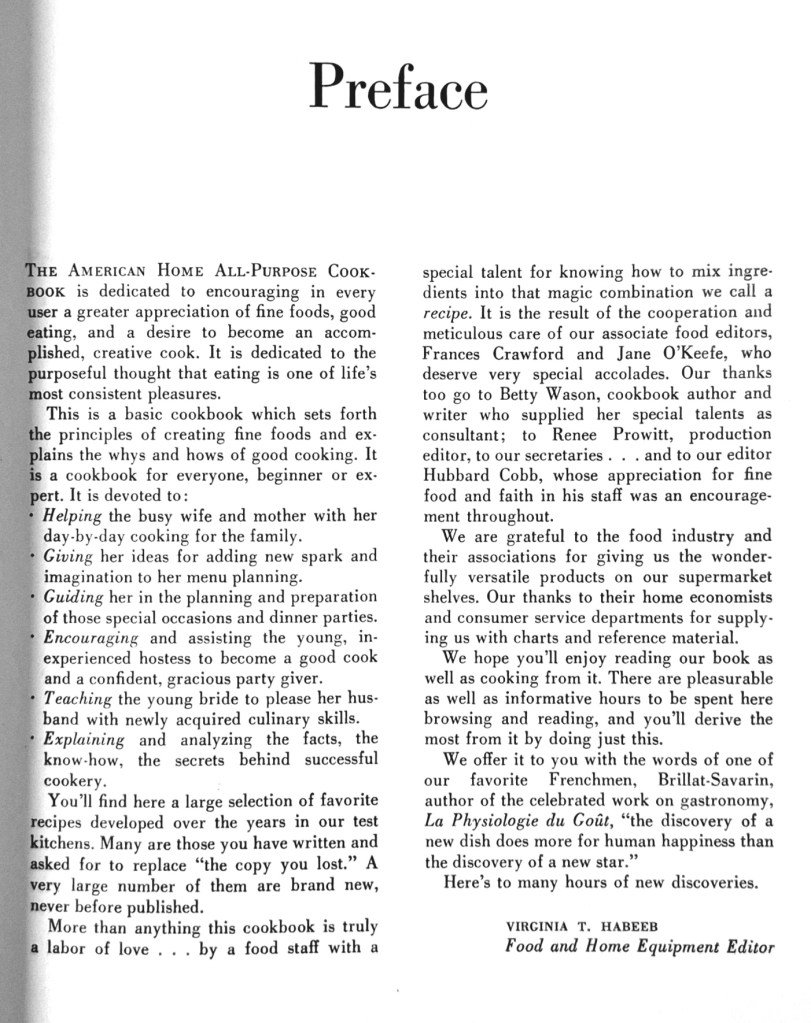
Tired: ryousai kenbo, Also Tired: busy wife and mother
Shortly before this I had been really soured by a search for a copy of Pie Marches On, a 1930’s tome put out by a Los Angeles celebrity chef credited with inventing the chiffon pie and also just making pie his whole personality, sort of, from what I can tell. The LA Public Library has a physical copy, which I expected, but the only digital copy was from (insert noises of bodily disgust here) a Google digitization of a physical copy they had borrowed(?) from Cornell University. Not only that, but the web viewer for this digital copy allowed me, an individual of little import, to read the entire thing for free…on the web viewer. I was also permitted to download one (1) page at a time. But if I wanted a gosh dang PDF of the whole thing? No no, I must be affiliated with a Particular Institution of Knowledge.
This is one of the many, many issues with copyright laws. Back when I was a grad student, I was able to get so many things ‘for free’. And you may say, well, Kelp, that’s because the University of California paid for access. But I can’t pay for the PDF of Pie Marches On. It’s already technically free for me to read. I just can’t read it outside of this wonky web viewer.
It’s also ridiculous because I am still part of a library system, several library systems, even, that allow me to request and probably get the physical copy that’s over in LA, for ‘free’. Hell, when I was in grad school, the power of interlibrary loan got me physical books sent from other countries, and all I had to do was click a button to file a request. At no point does the end reader normally ‘pay’ for access to stuff like this. You can argue it’s folded into fees and tuition, or taxes, or what have you, but my point is here that so often I am shut out of access to materials purely because I no longer can easily drive to my former university and use their library system. Did I mention this book was published in the 1930s and is full-ass out of print? Sigh.
This Was A Highlight?
Yeah, sorry, so! The American Home is indeed a magazine, and! You can read all of it! On a PDF you downloaded!
American Home Magazine Archive
courtesy of USModernist®
My original comment to the Bibliotheca discord upon this discovery was: “I spent who knows how long browsing the March 1960 issue, and I thoroughly read multiple articles, including this one on how fantastic new adhesives are (agreed! and yes they do think epoxy is game-changing)” My research in linguistic anthropology focused heavily on housekeeping magazines like these, so finding a little archive like this across the 20th century is hundreds of hours of future entertainment.
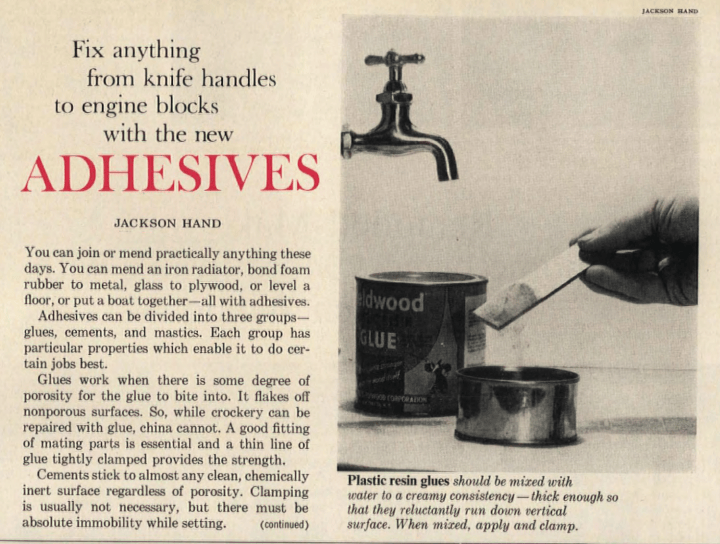
Remember your PPE, kids
Some blurbs from the archival website:
USModernist® is part of Modernist Archive, Inc., a 501(c)(3) nonprofit educational archive (EIN 26-3643357) providing donors, volunteers, and advocates the information and organization they require to passionately document, preserve, and promote residential Modernist architecture.
USModernist® is the largest open digital archive of midcentury Modernist houses in the world. Nearly every Wright, Neutra, Schindler, Lautner, and more – built and unbuilt. Enjoy!
This is one of the many reasons academics like me really hate Big Tech. Here we have a nonprofit that is doing the same work, and they just have a dang website with pdfs. No “what’s your academic affiliation”, no “you have to use our webreader or else”. There’s always the vagaries of (digital) copyright law that ties all peoples hands if they wanna be fully above-board, but there’s also just a lot of Techbro Gatekeeping Nonsense.
Going back to Interlibrary Loan, when I was a grad student in Northern California, at least once every academic period when I would be scraping around for sources would a book or journal I need show up as being just a hop, skip, and a jump across the Carquinez Bridge away at Google Books. But this is just a provocation. No one I have ever talked to has ever successfully had an ILL request fulfilled from there. By all accounts, it’s a graveyard. And not even the cool kind you can take goth coord shots at. There’s been some recent talk about how tech companies handle books in ways that effectively remove them from public access with current discussions of LLMs and AI, but this isn’t a new problem. It’s always been Privately Bad.
Um, So…Cheesecake?
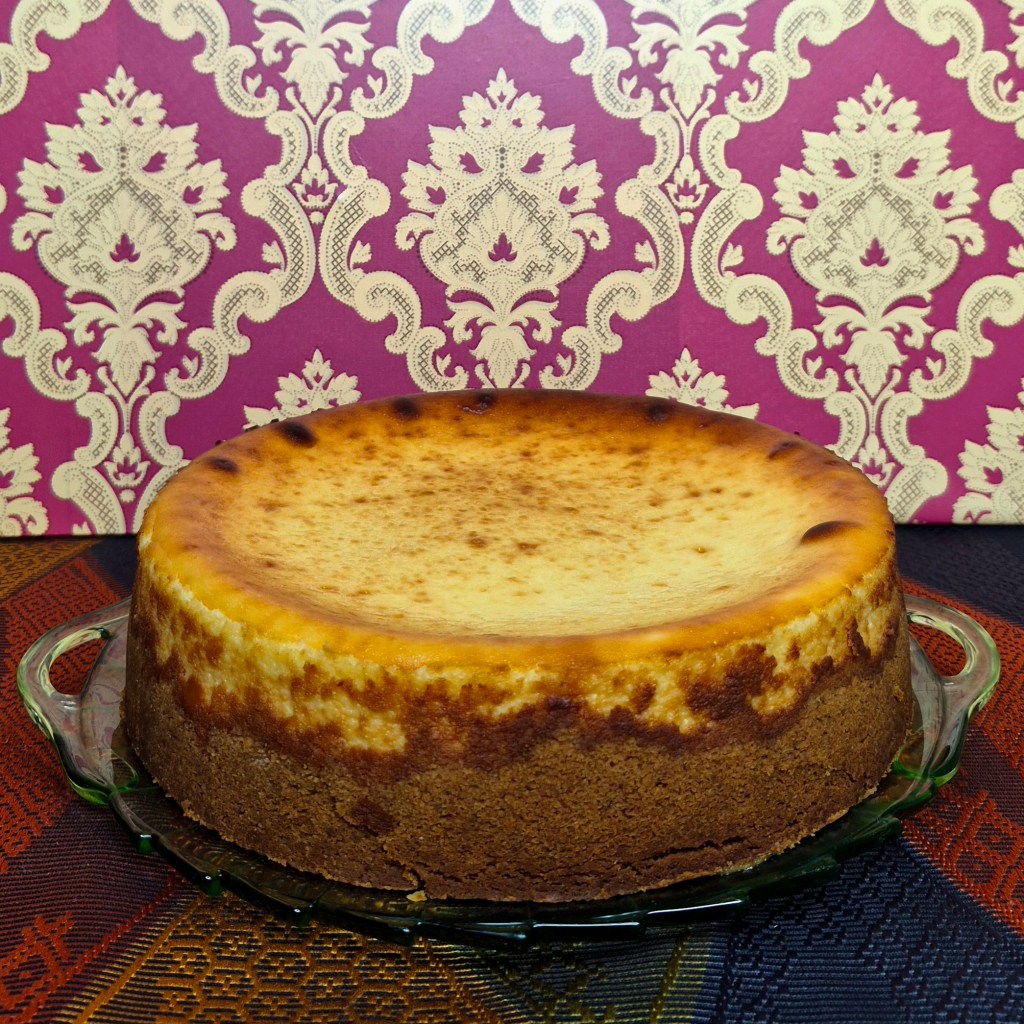
Maybe the clutter theme is also a metaphor for the organization of this post, but yeah, I made a cheesecake out of this book. After Jelly July, my resident taste-tester humbly requested several desserts that he particularly enjoys, and a proper New York style cheesecake was one of them. I didn’t have a recipe handy, so I started by thumbing through the aforementioned cookbook as it was already out, and lo, a whole Cheesecakes section.
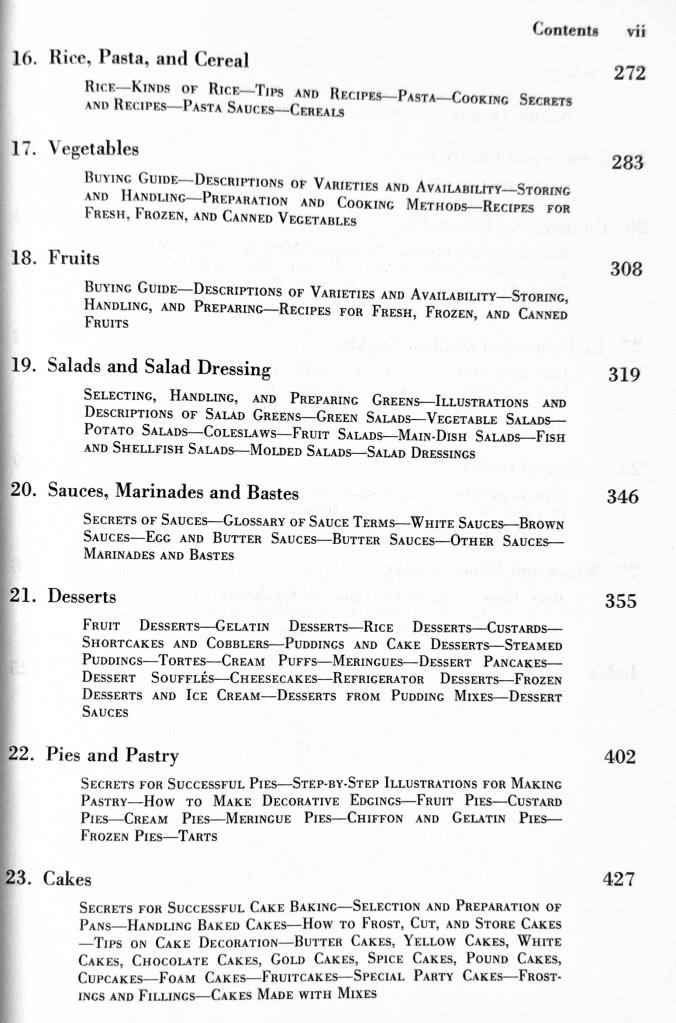
You heard it here first – American Home doesn’t consider cheesecake to be a pie or a cake
Also the cake subsections make a nice rap
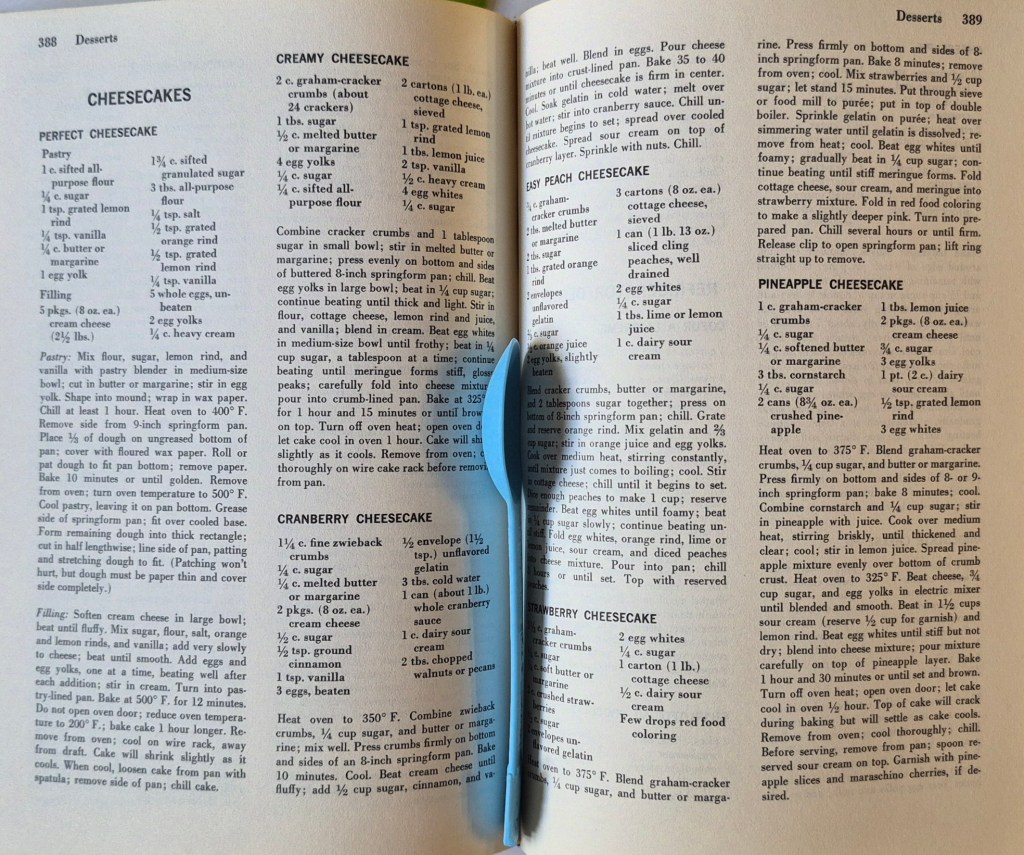
The first plain one had you make a traditional pie crust, which, yeah, nope. The second plain one had the typical graham cracker crust, but also a cottage cheese based filling? The other key difference is the first one had you bake at a high temp briefly, and then use carryover for an hour or so, where the second was firmly low-and-slow, though neither made you mess around with bain-marie, a positive. I’ve successfully made a cheesecake with the high-low method, so I ultimately just went with the first one sans pie crust.
The one concern I did still have was Depth. The first recipe wanted two and a half pounds of cream cheese, in addition to hella eggs and what not. Just how full is my 9” springform going to be?
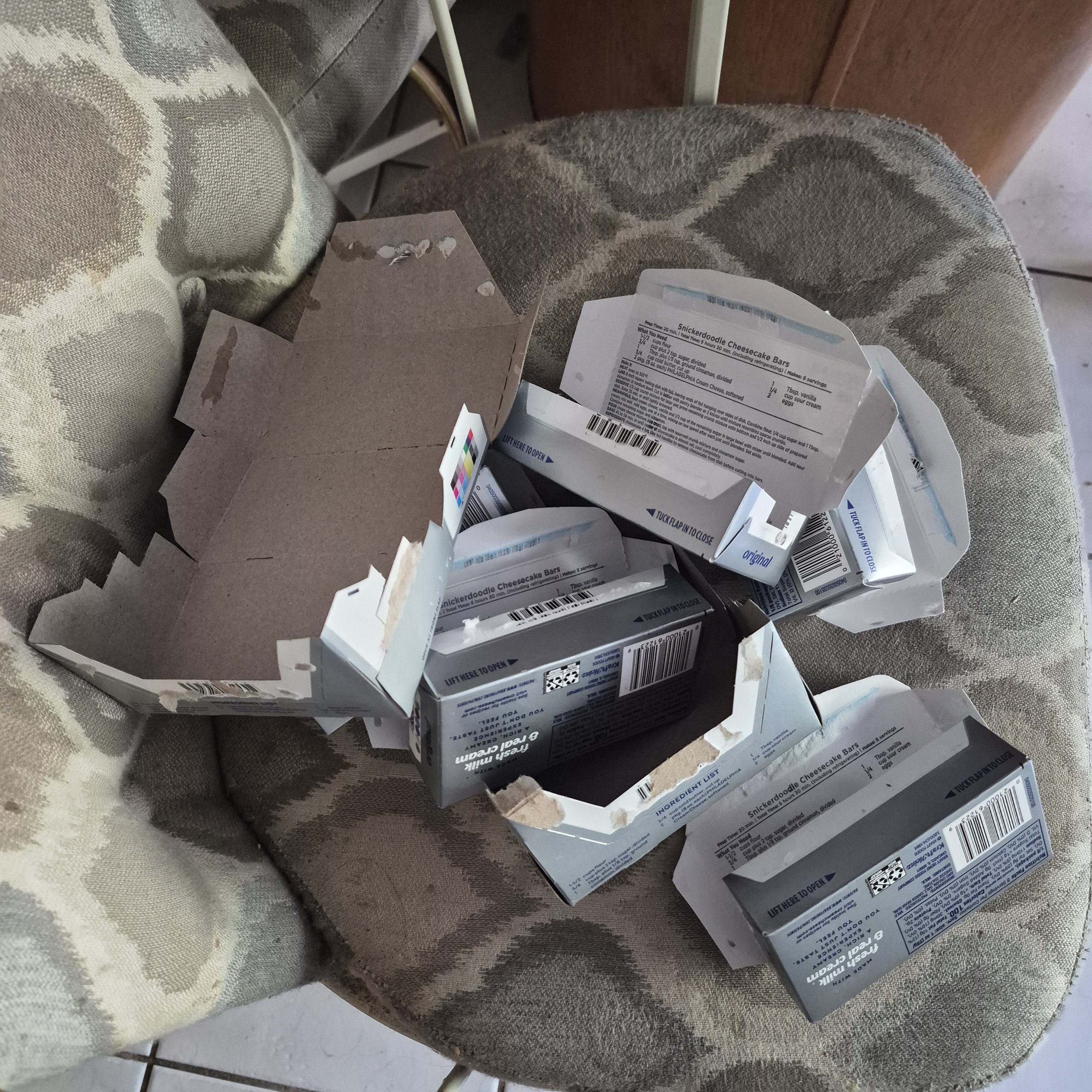
The resulting husks
The answer did turn out to be “too full”. Despite maximizing the carryover cooking, the final product is definitely underbaked. I would be mad at myself for not leaving it in the oven longer, but honestly I’m not sure that would have made much of a difference unless I like, doubled the time.
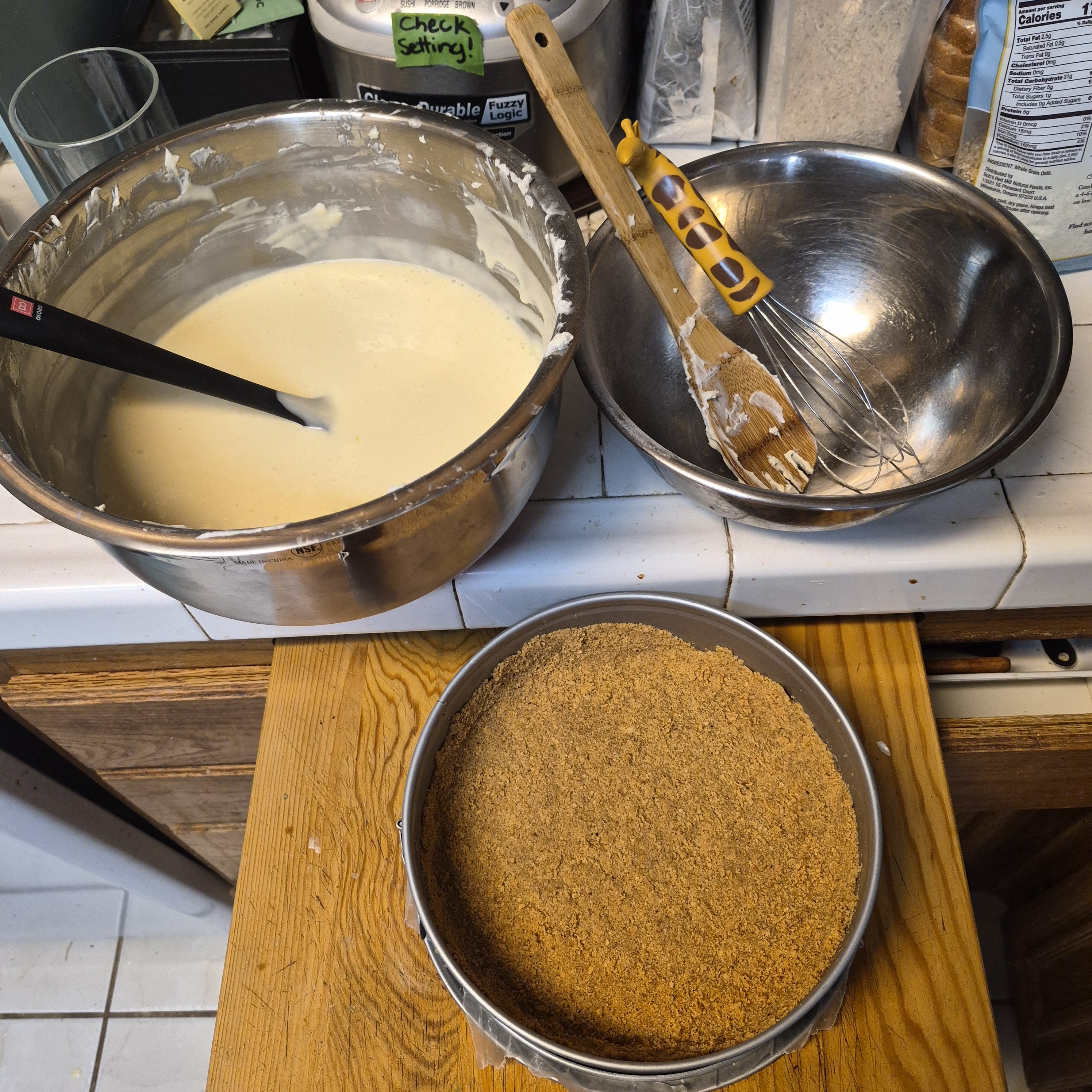
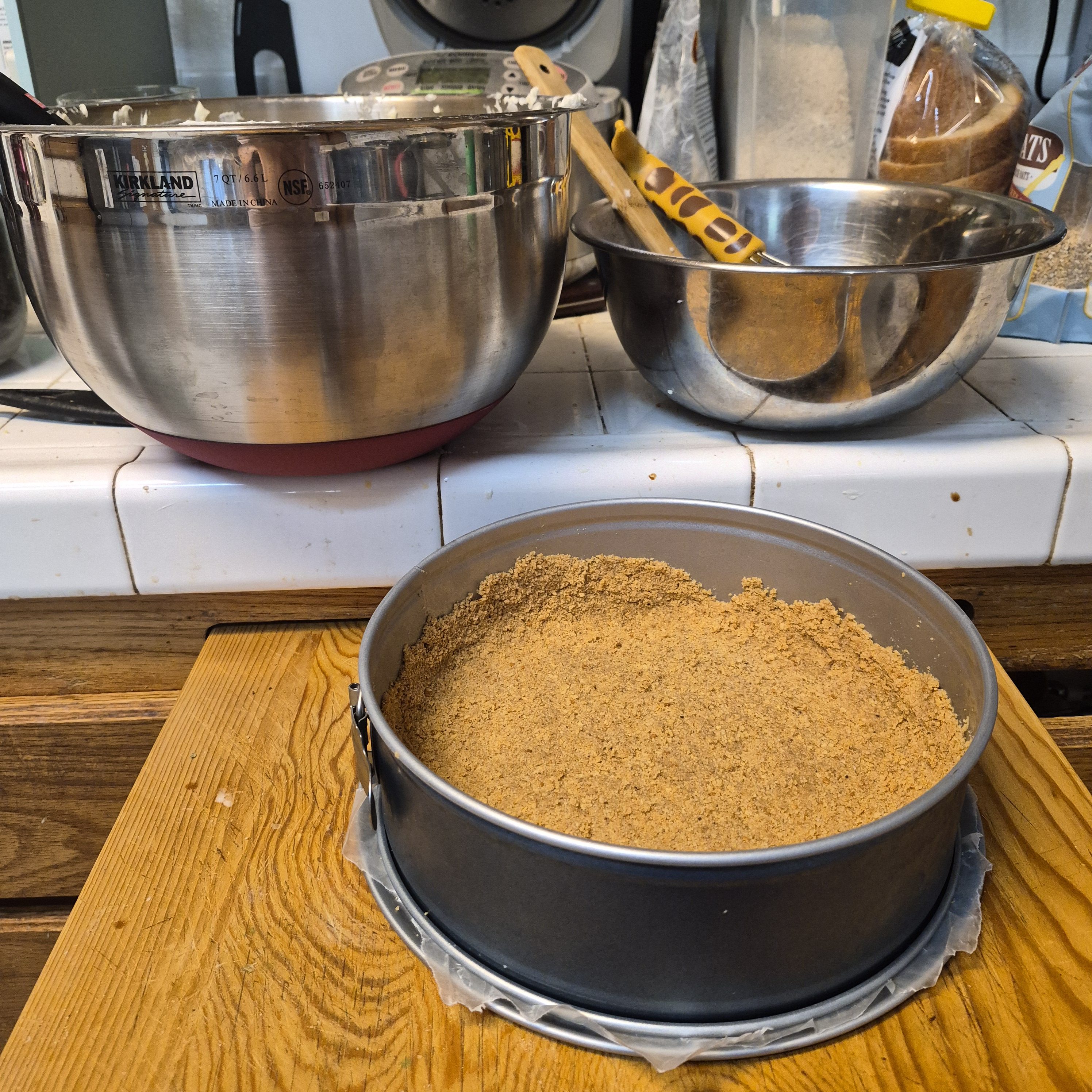
Normal sized mixing bowl for scale
The cheesecake itself isn’t even that tall, but it’s just so much Liquid, and for a baked cheesecake you expect that kind of flaky texture instead of the smoothness of no-bake. The outer inch or so is cooked to what I would expect, but the middle deffo isn’t, and it being a 9” pie, there’s a lot of middle.
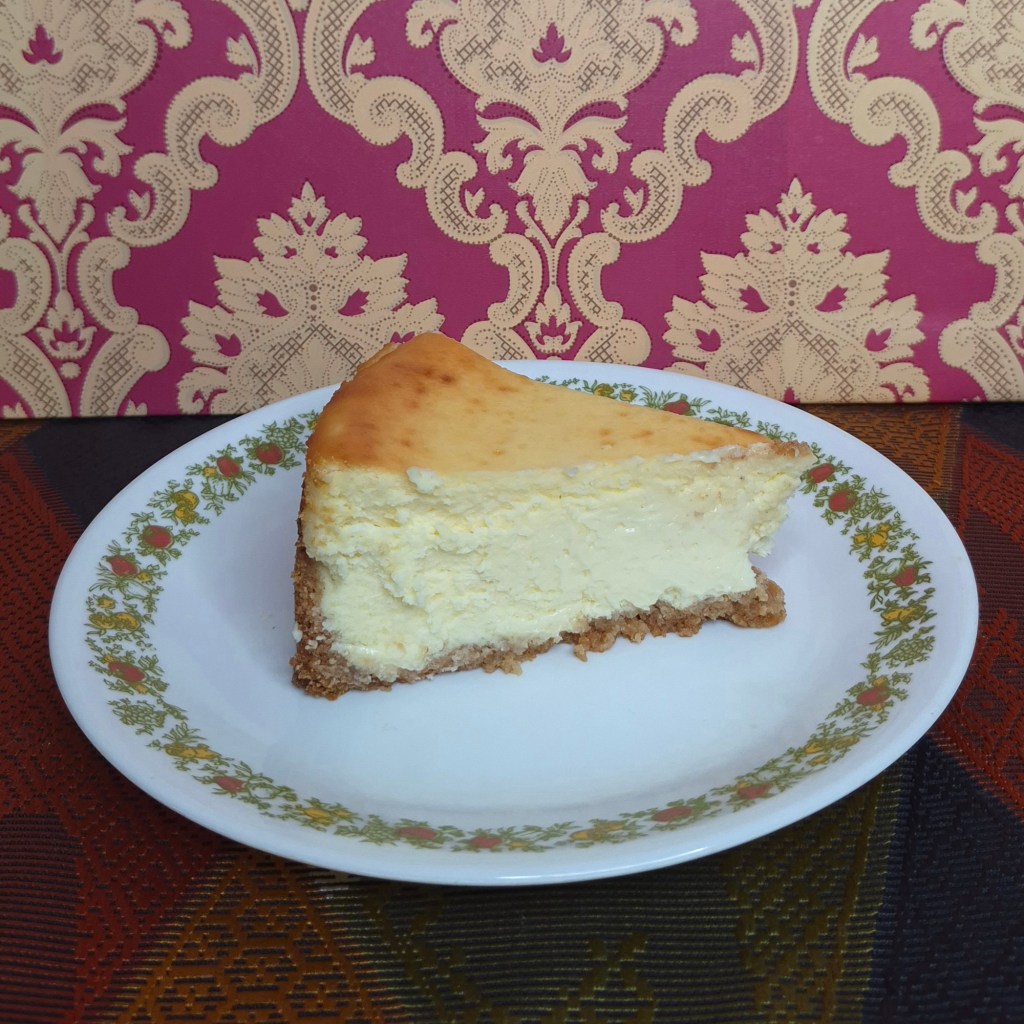
A median height slice
If you look closely, you can see the texture contrast between the top and outer edge versus the bottom center
To be clear, it’s completely edible, and it tastes fine. But I’m not posting the recipe here in detail cuz I have no idea how to adjust it so you, dear reader, would be assured to have a full baked cake o’ cheese. My oven does run cold, but with this method that can’t be it.

